Q3 2026 was the quarter simplification became law. The EU formally adopted, and published in the Official Journal, its slimmed-down ESRS and a voluntary standard for smaller companies. The UK set final rules for listed companies to report against UK SRS. Regulators from Australia to Malaysia moved to ease the cost of assurance without dropping the underlying disclosure, and Singapore consulted on its own ISSB-based standards.
Deadlines slipped as often as they landed. California pushed its first SB 253 Scope 1 and 2 deadline from 10 August to 10 November 2026. In the U.S., the SEC’s climate-rule rescission sat unresolved after its comment period closed, while the agency turned to proposing the rescission of the shareholder-proposal rule itself. At the same time, Japan wrote mandatory sustainability assurance into statute and South Korea fixed a 2028 start for mandatory ESG disclosure. Carbon pricing spread too, with Türkiye’s emissions trading regulation, the first compliance deadline under Japan’s GX-ETS and the UK’s CBAM rules all landing in the quarter.
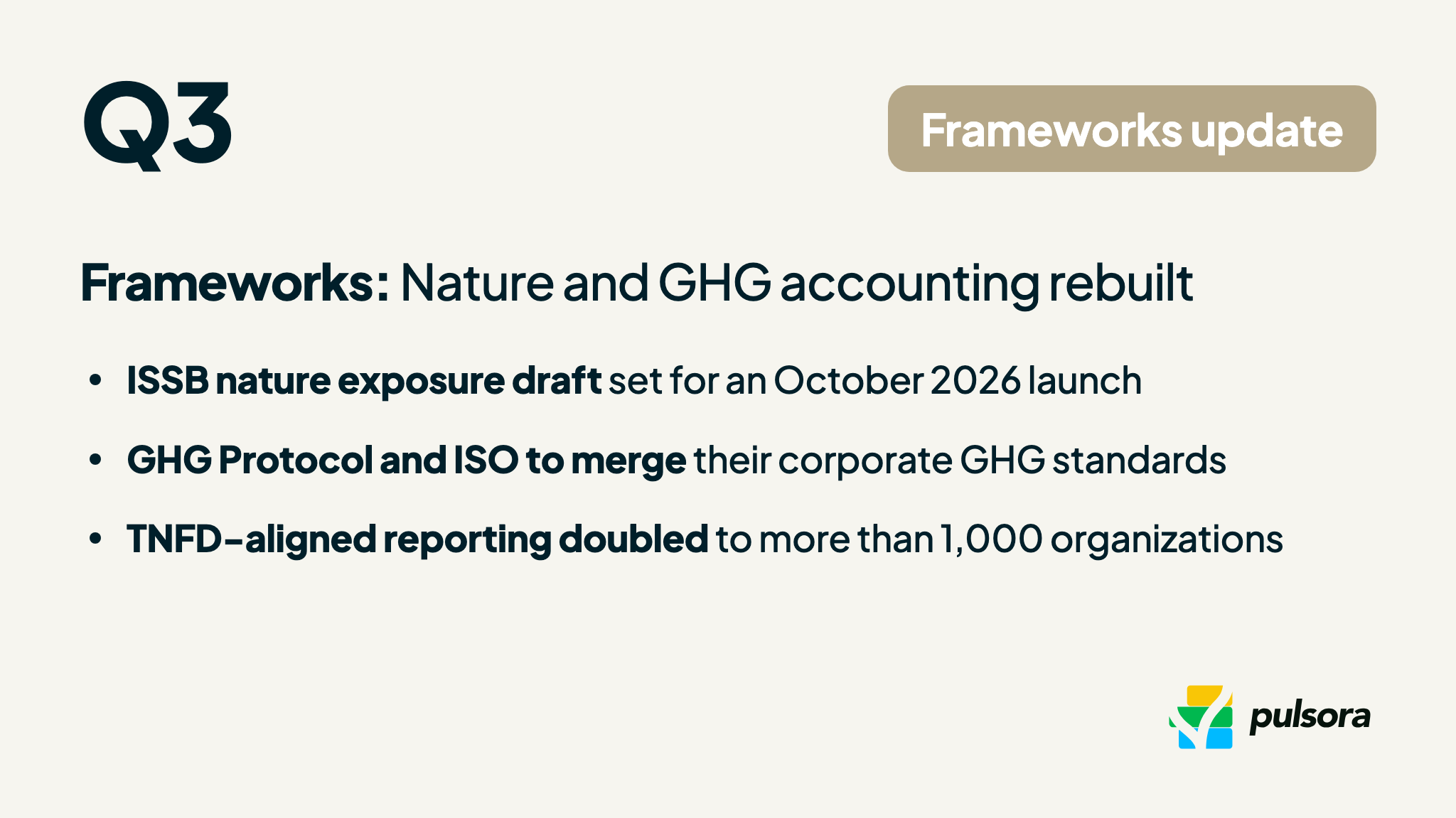
Standard setters kept building. The ISSB balloted its nature-related exposure draft for an October launch, the GHG Protocol and ISO agreed to merge their corporate GHG standards, GRI moved to a faster, streamlined Sector Standard format, and TNFD reported that nature-related reporting had doubled in a year.
For financial markets, the message was steadier than the headlines: fewer data points and longer runways, but the same direction of travel, toward ISSB-based disclosure, assured data and, increasingly, nature.
Takeaways for business & finance
- Simplification is now final, not proposed: The revised ESRS and the voluntary standard are in the Official Journal, and the UK’s listed-company rules against UK SRS are set. Reporting teams can now plan against fixed texts.
- Deadlines are moving, so check every date: California’s first SB 253 deadline moved to 10 November 2026, EPA pushed 2025 GHG reporting to March 2027 just after the quarter, and Malaysia deferred mandatory GHG assurance by a year.
- Assurance is being written into law: Japan enacted mandatory third-party assurance with a safe harbor, Korea set assurance from 2030, and Malaysia named ISSA 5000 as the required standard. Even where timing eases, the requirement is hardening.
- The U.S. retreat is widening beyond climate: The SEC stopped responding to shareholder-proposal no-action requests and proposed rescinding Rule 14a-8, and EPA repealed parts of its power-plant carbon standards.
- Carbon pricing is spreading and moving to the border: Türkiye published its ETS regulation, Japan’s mandatory GX-ETS reached its first deadline, Brazil consulted on MRV for its regulated market, and the UK made its CBAM regulations for a 1 January 2027 start.
- Nature and GHG accounting are being rebuilt at the core: An ISSB nature exposure draft, TNFD’s doubling in reporting, SBTN’s first food targets and a single GHG Protocol and ISO corporate standard all point to new baseline methods within two to three years.
Key regulatory and framework updates by region

Europe
Omnibus updates
On 3 July 2026, the European Commission adopted the revised sustainability reporting standards as two delegated acts: a simplified set of ESRS, cutting mandatory data points by more than 60% and total data points by more than 70%, and a voluntary standard, based on the VSME, that caps what in-scope companies may request from smaller value-chain partners. Both acts were published in the Official Journal on 21 September 2026: Delegated Regulation (EU) 2026/1563 (revised ESRS) and 2026/1560 (voluntary standard). The revised ESRS enter into force on 10 November 2026 and apply to financial years beginning on or after 1 January 2027, with the option to apply them for 2026. EFRAG published updated guidance for the voluntary standard the following day.
EFRAG followed with implementation material. On 23 July 2026 it opened a 100-day public consultation on the ESRS-40a exposure draft for certain non-EU undertakings (closing 31 October 2026), and on 28 August 2026 it released a draft list of data points for the revised ESRS, inviting “fatal flaw” comments by 23 October 2026. On 17 September 2026 it followed with a draft ESRS XBRL taxonomy for the revised standards, open for comment until 11 November 2026.
On 1 July 2026, the three European Supervisory Authorities launched parallel consultations (a discussion paper, in the EBA’s case) on simplifying EU Taxonomy (Article 8) disclosures: ESMA for non-financial undertakings and asset managers, the EBA for banks and investment firms, and EIOPA for insurers. All three closed on 12 August 2026, with technical advice due to the Commission by the end of October.
Green Claims Directive (GCD) updates
The Green Claims Directive remained stalled, still awaiting the Council’s first-reading position. In its place, the Empowering Consumers for the Green Transition Directive entered into application on 27 September 2026, banning unsubstantiated generic environmental claims and unreliable sustainability labels across the EU.
SFDR simplification updates
On 10 September 2026, the European Parliament’s ECON committee voted its first-reading report on the SFDR 2.0 proposal and a mandate to open negotiations with the Council. The report was tabled on 15 September and the mandate confirmed in plenary on 7 October, clearing the way for trilogues on the next version of SFDR.
The ESG Ratings Regulation began to apply on 2 July 2026. Existing providers had to notify ESMA by 2 August and must apply for authorization by 2 November 2026. ESMA also issued a public statement on third parties distributing ESG ratings during the transition.
Deforestation & product rules
On 17 September 2026, Commission Delegated Regulation (EU) 2026/2102 amending the EU Deforestation Regulation’s product scope was published in the Official Journal. It removes products such as bovine hides and leather and certain rubber articles, and adds others, including soluble coffee and certain palm-oil derivatives, from 30 December 2027. The main application dates are unchanged: 30 December 2026 for large and medium operators and 30 June 2027 for micro and small ones.
Under the Ecodesign for Sustainable Products Regulation, the ban on destroying unsold clothing and footwear began to apply to large companies on 19 July 2026, with medium-sized companies following in 2030.
Carbon markets & CBAM
On 17 July 2026, the Commission proposed a targeted revision of the EU ETS for 2031 to 2040 alongside an Electrification Action Plan, including a slower phase-out of free allocation for CBAM sectors, a limited role for international credits and the inclusion of permanent carbon removals.
On 9 July 2026 it adopted the first carbon-farming certification methodologies under the Carbon Removals and Carbon Farming Regulation. On 15 September 2026, Parliament adopted its amendments on the CBAM downstream extension and referred the file back to committee for negotiations with the Council.

North America
SEC Climate Disclosure Rule (USA)
The comment period on the SEC’s proposed rescission of its 2024 climate-disclosure rules closed on 3 August 2026. No final rule had been voted by the end of the quarter, and the SEC’s Regulatory Flexibility Agenda (14 August 2026) gave no target date.
The SEC widened its retreat into shareholder engagement. On 14 August 2026, the Division of Corporation Finance stated it would stop responding to Rule 14a-8 no-action requests entirely. On 16 September 2026 the Commission proposed rescinding Rule 14a-8, the federal shareholder-proposal rule through which most ESG proposals reach the ballot, alongside a proxy-solicitation modernization package. Comments are due by 20 November 2026.
California Senate Bills 253 & 261
The first SB 253 deadline moved. After withdrawing its initial regulation from the Office of Administrative Law in June, CARB published modified regulatory text on 27 July 2026 moving first-year Scope 1 and 2 reporting from 10 August to 10 November 2026, and clarifying the definitions of “doing business in California”, revenue and subsidiary.
CARB’s 1 September 2026 reporting guidance confirmed the 10 November deadline and first-year enforcement discretion (reporting from data already held, with or without assurance).
On 18 September 2026, CARB adopted the regulation by Executive Order R-26-006 and resubmitted it for OAL approval on 21 September. CARB also held a 21 July workshop on the follow-on regulation covering Scope 3 and assurance from 2027. SB 261 remained enjoined pending the Ninth Circuit appeal.
EPA (USA)
On 17 September 2026, EPA published a final partial repeal of the 2024 Carbon Pollution Standards for fossil-fuel power plants (effective 16 November 2026), together with a supplemental proposal to rescind the underlying greenhouse-gas findings and repeal the remaining standards (comments due 2 November 2026).

Asia-Pacific
Japan
On 15 July 2026, the Diet enacted an amendment to the Financial Instruments and Exchange Act that makes third-party assurance of sustainability information in annual securities reports mandatory, introduces a registration regime for assurance providers, and creates a civil-liability safe harbor for forward-looking sustainability information. On 15 September 2026, the FSA amended its designation of sustainability disclosure standards to add the SSBJ’s first Practical Solution, on using GHG emissions data reported under Japan’s national reporting scheme.
Japan’s mandatory GX-ETS reached its first deadline on 30 September 2026. Operators emitting 100,000 tonnes of CO₂ or more a year had to notify METI that they are in scope and submit transition plans, which METI publishes. Allowance allocation follows from FY2027.
China
On 2 September 2026, the Ministry of Ecology and Environment issued the national carbon market allowance allocation plan covering power for 2025 to 2026 and steel, cement and aluminum smelting for 2026, the first plan to allocate all four sectors together. On 30 September 2026, the Ministry of Finance published for consultation application guidance for its climate disclosure standard together with nine industry guides (power, steel, coal, oil, fertilizer, aluminum, hydrogen, cement and automobiles), with comments due by 26 October 2026.
Australia
On 21 September 2026, ASIC published REP 839, its first review of mandatory sustainability reports (40 of the 312 lodged by Group 1 entities with December 2025 year-ends). It found clear improvement on earlier voluntary reporting but weaker forward-looking and judgment-based disclosure.
The Treasury opened a consultation on improving the efficiency of climate-related financial disclosures on 23 August 2026 (closed 5 October), including options on assurance settings and supply-chain data requests. On greenwashing, the court ordered Fiducian Investment Management Services to pay A$7.3 million on 11 August 2026 over misleading claims about an ESG fund, ASIC’s fourth greenwashing civil-penalty outcome.
South Korea
On 8 July 2026, the Financial Services Commission set out its final roadmap for mandatory ESG disclosure under KSSB standards. Disclosure is required from 2028 (for FY2027) for KOSPI companies with consolidated assets of KRW 10 trillion or more, widening to KRW 5 trillion in 2029, with Scope 3 deferred to 2031 to 2033, mandatory third-party assurance from 2030 and a three-year safe harbor.
Singapore, Malaysia & Hong Kong
On 27 July 2026, ACRA’s Interim Sustainability Standards Committee consulted on draft Singapore Sustainability Disclosure Standards, SFRS S1 and S2, based on IFRS S1 and S2, with only the climate standard to be mandatory. Comments close on 25 October 2026.
On 17 September 2026, Malaysia’s Advisory Committee on Sustainability Reporting deferred mandatory reasonable assurance of Scope 1 and 2 emissions by a year (to 2028 for Group 1 issuers) and specified ISSA 5000 for assurance engagements.
The HKMA launched a consultation on Phase 2B of the Hong Kong Taxonomy on 7 September 2026, adding new mitigation and transition activities and an adaptation methodology. MAS and the People’s Bank of China agreed on 17 September 2026 to extend taxonomy interoperability work from green to transition activities.
Other regions

UK
On 30 September 2026, the FCA published PS26/19, replacing its TCFD-aligned listing rules with comply-or-explain reporting against UK SRS S1 and S2 for accounting periods beginning on or after 1 January 2027, with one-year relief for Scope 3 and two years for non-climate disclosures. It is consulting on proportionate application in GC26/6 until 28 October 2026.
Following its CP26/17 consultation, the FCA replaced product-level TCFD reports with targeted requirements: a periodic materiality assessment of climate risk for each product and on-request emissions data for eligible clients. The retail rules are in force from 25 September 2026 and the institutional rules from 30 June 2027.
Between July and September 2026 the UK made the secondary legislation for its Carbon Border Adjustment Mechanism, covering the CBAM rate and carbon price relief, administration, and emissions and verification, ahead of its 1 January 2027 start for aluminum, cement, fertilizer, hydrogen, and iron and steel imports. The UK ETS also extended to domestic maritime from 1 July 2026, covering ships of 5,000 gross tonnes and above.

Türkiye
On 27 August 2026, Türkiye published its Emissions Trading System Regulation under the 2025 Climate Law. It entered into force immediately and opens with a pilot phase for installations emitting 50,000 tonnes of CO₂e or more a year, with rules on permits, verification, free allocation and surrender.
Brazil
Brazil’s Ministry of Finance consulted on a phased MRV timetable for its regulated carbon market (SBCE) from 28 July to 28 August 2026, starting in 2027 with sectors including cement, steel, aluminum, pulp and paper, oil and gas and air transport. It also consulted on rules for international transfers of carbon credits under Article 6 of the Paris Agreement.
Voluntary frameworks updates
Global Reporting Initiative (GRI)
On 22 September 2026, GRI introduced a streamlined format for Sector Standards that identifies a sector’s likely material topics and points to existing Topic Standards rather than adding sector-specific disclosures. On 28 September it launched a pilot project under the new format to develop a Food and Beverages Sector Standard. Revision of the pollution Topic Standards continued after consultation, with approval targeted for May 2027.
International Sustainability Standards Board (ISSB)
At its July 2026 meeting, the ISSB confirmed due process and began balloting the exposure draft of its nature-related disclosures Practice Statement, setting a 120-day comment period and an October 2026 publication date. It also decided to enhance the six SASB Technology & Communications standards.
On 29 July 2026 it proposed an update to the ISSB digital taxonomy reflecting the December 2025 GHG amendments to IFRS S2, and in September renamed its human capital research project “Workforce-related Disclosures”.
On 18 August 2026 the IFRS Foundation Trustees announced a five-year plan that includes opening an office in Geneva in 2027 as the seat of the ISSB, and proposed targeted Constitution amendments (comments until 16 November 2026).
Science Based Targets initiative (SBTi)
Implementation of Net-Zero Standard V2.0 began. On 14 July 2026 SBTi Services launched a Readiness Assessment Service for companies with existing targets (V2.0 becomes operational in 2027 and mandatory for new targets in 2028).
On 13 August it revised its mandatory five-year review guidance and target statuses, with the new statuses shown on the Target Dashboard from 24 September 2026.
SBTi also opened a second consultation on its Power Sector Net-Zero Standard (15 July, closed 7 September) and a call for input on revising its FLAG Standard (30 July).
CDP (Carbon Disclosure Project)
CDP’s 2026 disclosure cycle ran through the quarter, with expanded nature coverage (including ocean), a broader forests scope and closer alignment with TNFD, GRI, SBTN and the GHG Protocol. Responses had to be submitted by the 16 September 2026 scoring deadline to be eligible for scoring. The final response deadline is 28 October 2026.
SBTN (The Science Based Targets Network)
On 15 September 2026, SBTN announced 14 more companies with validated progress, including the first science-based targets for food (seafood) and new land targets, alongside a business-case report, “Step Up for Nature”. It confirmed that Science-Based Targets for Nature 2.0 would launch on 13 October 2026.
TNFD (Taskforce on Nature-related Financial Disclosures)
On 21 September 2026, the TNFD’s 2026 Status Report found more than 1,000 organizations across 56 countries publishing TNFD-aligned disclosures, double the 2025 total, and 802 committed adopters, including financial institutions with US$26.6 trillion in assets under management. On 22 September it released final sector guidance for technology and communications, bringing its sector guidance to 18 sectors.
GHG Protocol
On 29 July 2026, the GHG Protocol and ISO announced that they will merge their corporate standards (the Scope 1, 2 and 3 and Actions and Market Instruments standards and ISO 14064-1) into a single co-branded standard, with an integrated consultation planned for Q2 2027. Its market-instruments feedback summary (23 September) showed broad support for a multi-statement inventory, with the final consolidated standard slated for Q4 2028.
NGFS (Network for Greening the Financial System)
On 21 September 2026, the NGFS published its 2026 Guide for Supervisors on integrating climate and nature-related financial risks into prudential supervision, its first update since 2020.
ICVCM (Integrity Council for the Voluntary Carbon Market)
On 4 August 2026, the Integrity Council approved three more programs as CCP-Eligible (BioCarbon Standard, Cercarbono and Plan Vivo), meaning CCP-Eligible programs now account for more than 95% of cumulative voluntary carbon market issuance.
Impact on companies & investors
- Re-baseline EU reporting now: With the revised ESRS final and EFRAG’s data point list out, companies can map their double-materiality assessments to the smaller standard and decide whether to apply it early for FY2026.
- Use the extra time for data, not delay: California’s November deadline and the softer assurance timetables in Malaysia and Australia buy months, not exemptions. Controls and audit trails are still the gating item.
- Expect less shareholder pressure through U.S. channels: If Rule 14a-8 is rescinded, ESG engagement in the U.S. moves to state law, company bylaws and private dialogue. Global investors will lean harder on ISSB-based disclosure elsewhere.
- Prepare for a new GHG and nature baseline: The GHG Protocol and ISO merger, SBTi V2.0 and the ISSB nature draft will change inventories and targets within two to three years. Build flexible data models rather than one-off reports.
Looking ahead to Q4 2026
Q4 opens with the ISSB’s nature exposure draft, due to launch on 22 October at CBD COP17, and SBTN’s Science-Based Targets for Nature 2.0 on 13 October. California’s first SB 253 reports fall due on 10 November (subject to OAL approval), ESG rating providers must apply to ESMA by 2 November, and SFDR 2.0 moves into trilogues.
Just after the quarter, EPA signed an interim final rule moving 2025 GHG Reporting Program submissions from 30 October 2026 to 10 March 2027, and India’s ICAI published SSA 5000, its sustainability assurance standard, effective for periods beginning on or after 1 April 2027.
- Closing consultations: EFRAG data points (23 Oct), Singapore SFRS S1/S2 (25 Oct), China’s climate guidance (26 Oct), GC26/6 (28 Oct), ESRS-40a (31 Oct), ESRS XBRL taxonomy (11 Nov), IFRS Constitution (16 Nov), SEC Rule 14a-8 (20 Nov)
- Hard deadlines: CDP final responses (28 Oct), California SB 253 (10 Nov), revised ESRS in force (10 Nov), ISSA 5000 effective (15 Dec), EUDR applies (30 Dec), UK CBAM starts (1 Jan 2027)
- Decisions to watch: a final SEC climate-rule rescission, ESA advice on Taxonomy disclosures, Australia’s assurance reforms
The throughline into year-end is that the rules are now mostly written: the work moves from tracking proposals to meeting dated obligations, with assured data as the common denominator.


