Financed Emissions Software: Measure Your Portfolio Under PCAF
Pulsora is an enterprise platform for financed emissions, applying the Partnership for Carbon Accounting Financials (PCAF) methods to your loans and investments, with a data quality score and lineage behind every value.
Recognized by industry analysts. Pulsora ranked first in the ISG Buyers Guide 2025 for Sustainability Emerging Providers, classified Exemplary, and is named a Verdantix Smart Innovator for ESG reporting and data management.Sources: ISG Buyers Guide 2025; Verdantix Smart Innovators 2025.
Financed emissions are the emissions tied to a financial institution's loans and investments
Financed emissions are the greenhouse gas emissions linked to what a bank, insurer, asset manager, or private equity firm lends to and invests in. The Greenhouse Gas (GHG) Protocol counts them in Scope 3 Category 15. The Partnership for Carbon Accounting Financials (PCAF) built on that category with its own, more detailed standard, and PCAF is now how the financial sector measures and reports financed emissions.
For a financial institution the portfolio is the footprint, so financed emissions usually outweigh operational emissions by far.
Financed emissions are hard to measure because the data sits with investees and borrowers
Your own systems carry the financial side: outstanding loans, equity positions, and asset values. The emissions side sits with the companies you finance. Three problems compound.
Some companies report their Scope 1 and Scope 2 emissions. Many do not measure yet, so you fill the gaps with estimates.
PCAF attributes a company's emissions to you in proportion to your financing share, so loan balances, positions, and company values have to line up.
Every holding carries a PCAF data quality score, and you are expected to show the scores improving over time.
Start with the data you have, score its quality honestly, and improve it every cycle.
Pulsora applies the PCAF methods in one system of record
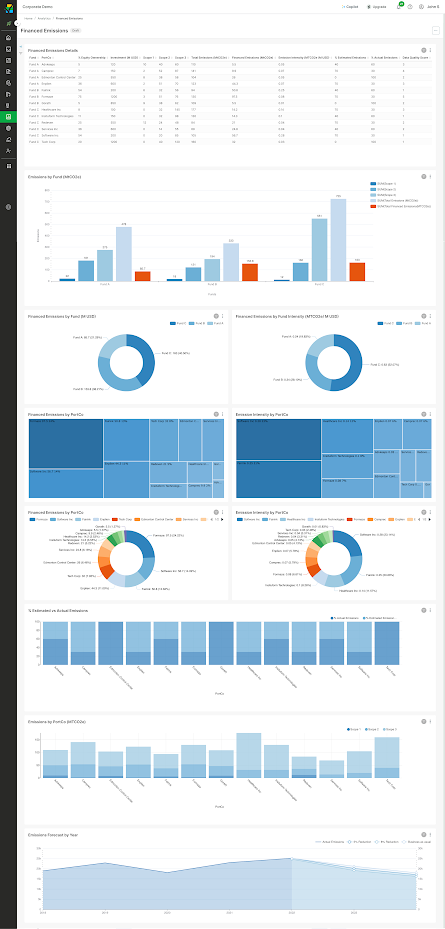
Pulsora embeds the PCAF methods directly into the calculation workflow: asset-class formulas, estimation logic, and data quality scoring. It applies them consistently across large, complex portfolios, so the same financed emissions data supports your PCAF disclosure, your regulatory reporting, and investor requests without rework.
When lending and investing make up most of your inventory, one system of record keeps every attributed value traceable to the holding and the source behind it.
When portfolio companies report at different levels of maturity, data quality scores show which values are reported and which are estimated. See ESG management for private equity portfolios.
For financed emissions the deciding factor is consistency: the same method, applied the same way, across every holding.
Financed emissions software needs PCAF formulas, data quality scoring, and lineage on every value
Use these criteria to judge any financed emissions platform. They are written so you can score a demo against them.
One model, every framework you report to
Calculate financed emissions once on one layer, then report them to each framework that asks for them.
Measuring your own suppliers instead? See supplier and business value chain data collection.
Pick one holding in your portfolio and trace its attributed emissions back to the source data and the quality score behind them. Where the source data or the quality score is missing, the record behind that value has a gap. Bring that one holding to Pulsora.
See how Pulsora measures financed emissionsFrequently asked questions
What are financed emissions?
Financed emissions are the greenhouse gas emissions linked to a financial institution's loans and investments. The GHG Protocol counts them in Scope 3 Category 15, and for most banks, insurers, and investors they are the largest part of the footprint.
What is PCAF?
The Partnership for Carbon Accounting Financials (PCAF) is an industry-led partnership of financial institutions. Its Global GHG Accounting and Reporting Standard for the Financial Industry sets out how to measure and report financed emissions.
How does PCAF relate to Scope 3 Category 15?
Financed emissions started as Scope 3 Category 15 under the GHG Protocol. PCAF built a more detailed method on top of it, with formulas per asset class, attribution by financing share, and data quality scoring, and that method is now how the financial sector measures Category 15.
What are PCAF data quality scores?
PCAF scores each holding from 1 to 5. The best scores use emissions the company reported, with verified emissions scoring highest, and Score 5 uses economic estimates. The exact rules differ by asset class. Most institutions start with a mix and improve the scores over time.
What is the best financed emissions software?
The best option applies the PCAF asset-class formulas consistently, scores data quality for every holding, and keeps every attributed value traceable to its source. Pulsora embeds the PCAF methods into one system of record for this.
- ISG Buyers Guide 2025, Sustainability Emerging Providers (Pulsora ranked first, classified Exemplary).
- Verdantix Smart Innovators, ESG Reporting and Data Management Software, 2025.
- Partnership for Carbon Accounting Financials (PCAF), Global GHG Accounting and Reporting Standard for the Financial Industry, Part A: Financed Emissions, third edition, 2025.
- Greenhouse Gas Protocol, Corporate Value Chain (Scope 3) Standard, Category 15.
- Pulsora, The ultimate guide to financed emissions and PCAF.


