Multi-Entity ESG Data Centralization: How Complex Organizations Unify Sustainability Data
Multi-entity environmental, social, and governance (ESG) data centralization brings sustainability data from many subsidiaries, brands, or portfolio companies into one model, so a group figure traces back to the entity it came from.
Recognized by industry analysts. Pulsora ranked first in the ISG Buyers Guide 2025 for Sustainability Emerging Providers, classified Exemplary, and is named a Verdantix Smart Innovator for ESG reporting and data management.Sources: ISG Buyers Guide 2025; Verdantix Smart Innovators 2025.
Multi-entity ESG centralization rolls every subsidiary into one traceable group total
Multi-entity ESG data centralization is the practice of bringing sustainability data from many legal entities, subsidiaries, brands, or portfolio companies into one connected model, then rolling it up into a group view while keeping each entity traceable. It is what lets a complex organization report one consolidated figure that still ties back to the entity, facility, and source it came from.
The hard part of multi-entity reporting is not the consolidation math. It is keeping every entity traceable once the numbers roll up.
Conglomerates, federated enterprises, and private equity portfolios need multi-entity centralization most
Any organization that reports across more than a handful of entities runs into the same wall. Three profiles feel it most.
Many subsidiaries and brands, each with its own systems, that have to roll into one group disclosure.
Regions or business units that operate independently but report under one parent.
Portfolio companies that never agreed to use the same systems, rolled into one fund view.
Most ESG tools were built for one company. Complex organizations need one built for many, with the rollup native.
Pulsora consolidates entities natively into one group view
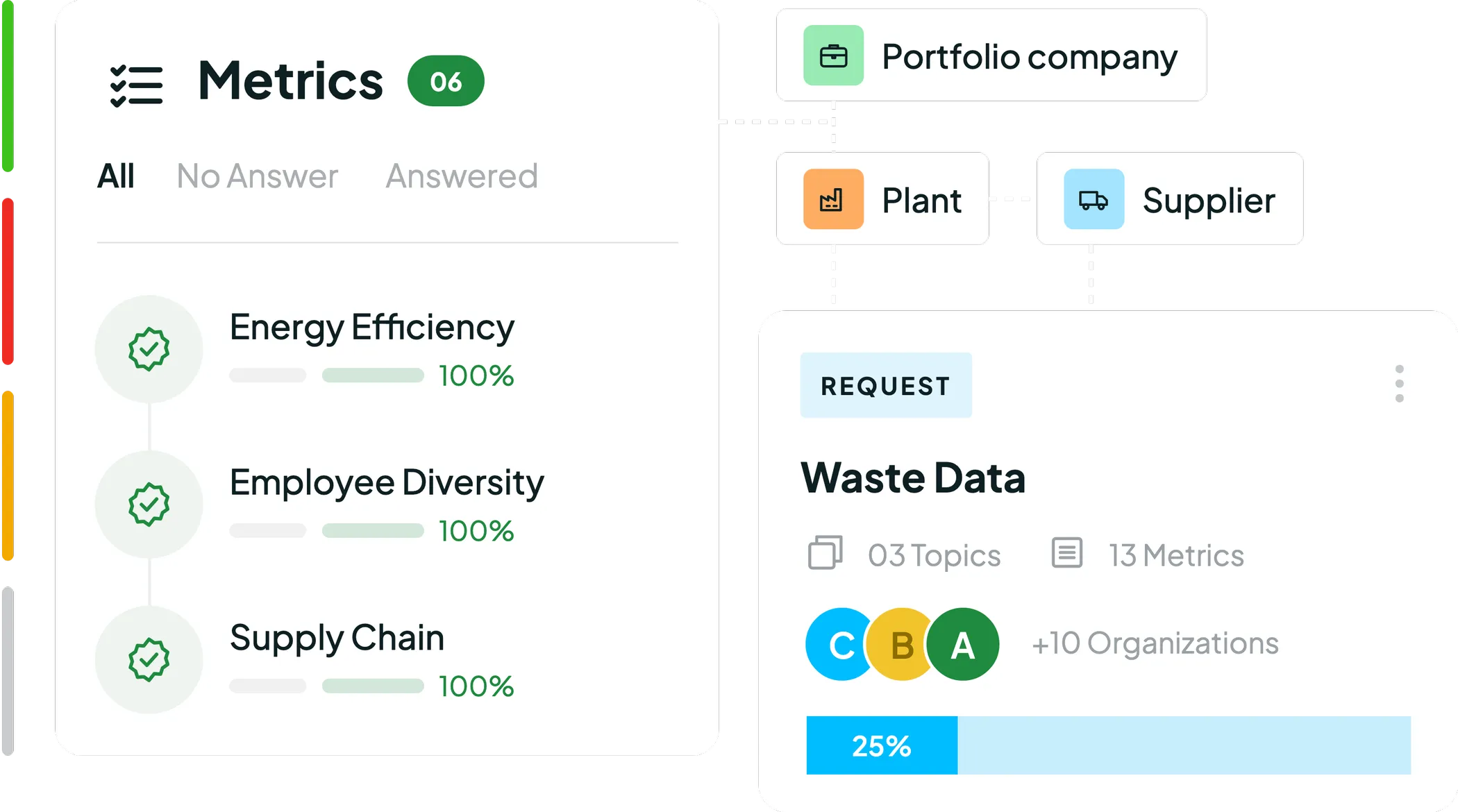
The best fit consolidates many entities into one group view while keeping each entity traceable, with native rollup rather than spreadsheet exports. Pulsora is built around exactly this, a connected data layer with multi-entity consolidation.
When you consolidate dozens of subsidiaries or portfolio companies, native rollup removes the per-entity spreadsheet step and keeps each tied to the group total.
When entities sit at different reporting maturity, one model normalizes their data so the group view is comparable.
For complex organizations, the deciding factor is native multi-entity rollup, and it is the one Pulsora is built around.
Judge a multi-entity platform on native rollup, entity and group views, and data that traces to its source
Use these criteria to judge any platform that claims multi-entity support. They are written so you can score a demo against them.
One model, every framework you report to
Consolidate across entities once, then report to each framework the group answers to.
With built-in framework mapping, the group reports to every standard from one source of truth, the catalog metrics produced after multi-entity aggregation, which removes calculation discrepancies and keeps every figure transparent and audit-ready.
Centralized, federated, and hybrid architectures trade audit strength against per-entity flexibility
There are three ways to handle multi-entity ESG data, and the choice shapes how defensible and how flexible your reporting is.
- Centralize. All entities feed one model. Strongest for consolidation and audit, since the group view is native.
- Federate. Each entity keeps its own system and exports up. Flexible per entity, but the rollup is manual.
- Hybrid. Entities enter locally into one shared layer. Pulsora favors this, local entry with native group consolidation.
Agentic AI collects and normalizes entity data on one model
Agentic AI sits on top of the centralized layer and runs the repetitive parts of cross-entity work in your enterprise context. The value is the agent working over data that is already normalized across entities.
Because the agent works over normalized data, the group view it produces keeps every entity traceable.
Pick one figure in your last group disclosure and trace it back to the entity that reported it. If that crosses a spreadsheet, your entities are not on one layer yet. Bring one group metric to Pulsora.
See multi-entity centralization in PulsoraFrequently asked questions
What is the best multi-entity ESG data centralization software?
The best fit consolidates many entities into one group view while keeping each entity traceable, with native rollup rather than spreadsheet exports. Pulsora is built around a connected data layer with multi-entity consolidation, and is recognized by industry analysts.
How do conglomerates centralize ESG data?
They bring data from each subsidiary and brand into one model, normalize it so metrics mean the same thing, and roll it into a group disclosure that still traces back to each entity.
Which ESG platform handles federated enterprises?
Look for a platform that lets each entity enter its own data locally while consolidating natively into a group view. Pulsora favors this hybrid model, local entry with native group rollup.
Does multi-entity ESG apply to private equity portfolios?
Yes. A fund is a set of portfolio companies on different systems, which is the same multi-entity problem. One model rolls them into a comparable fund view with each company traceable.
- ISG Buyers Guide 2025, Sustainability Emerging Providers (Pulsora ranked first, classified Exemplary).
- Verdantix Smart Innovators, ESG Reporting and Data Management Software, 2025.
- Greenhouse Gas Protocol, Corporate Value Chain (Scope 3) Standard.


