TL;DR: Supplier engagement is the operational layer between Scope 3 data collection and CDP disclosure. The strongest programs make participation easy, segment suppliers by materiality, collect data continuously, and document gaps transparently.
You know what data you need. That part's solved.
The harder problem, the one that quietly derails even well-resourced Scope 3 programs, is getting hundreds or thousands of suppliers to submit emissions data on time, in a usable format, at a quality level that supports CDP disclosure and withstands regulatory scrutiny.
Most sustainability teams dramatically underestimate how operationally complex supplier engagement is until they're already mid-cycle, chasing responses via email and reconciling inconsistent spreadsheets the week before a reporting deadline.
This article gives sustainability leaders a practical framework for designing and running a supplier engagement program that actually works.
Why supplier response rates stay low
According to Sphera's 2025 Scope 3 Report, which surveyed 315 sustainability professionals across 18 industries, 79% of companies say supplier data availability is their top challenge in achieving accurate Scope 3 emissions disclosures. That number hasn't meaningfully budged year over year. And it won't, as long as companies treat supplier engagement as a data collection task rather than a relationship management problem.
Here's what's actually happening on the supplier side:
Your supplier is probably serving dozens of enterprise customers, each with different questionnaire formats, different portal logins, different timelines, and different definitions of what "emissions data" means.
Responding to yours requires someone in their organization, likely not a dedicated sustainability professional, to interrupt their actual job, interpret your request, locate the underlying activity data, attempt to calculate something in a format they've never used before, and submit it through a system they may never log into again nor see any immediate business benefit from.
This is a design problem, and it's entirely solvable.
| Supplier barrier | What it looks like | How to reduce friction |
|---|---|---|
| Too many formats | Different customers send different questionnaires, portals, and timelines. | Use one guided questionnaire with clear definitions. |
| Low internal ownership | The request lands with someone who is not a sustainability specialist. | Provide plain-language instructions and support. |
| No visible benefit | Suppliers submit data and never hear back. | Share benchmarking, recognition, or procurement-linked incentives. |
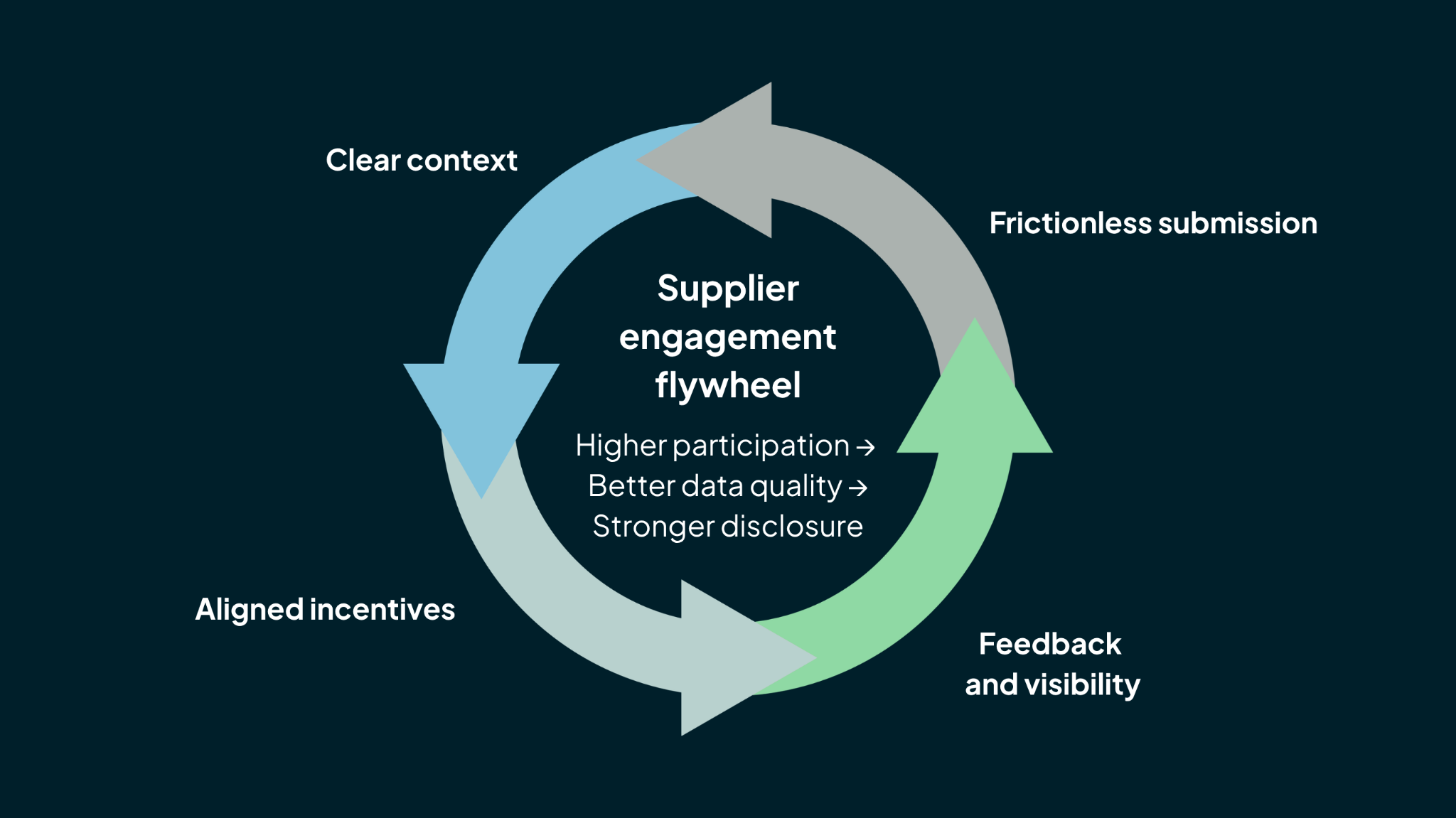
The four things that actually drive supplier participation
1. Make the ask frictionless
Suppliers respond when responding is easy. That means a single, standardized questionnaire with clear definitions, a guided submission process, and multiple input options, not a custom spreadsheet attached to an email from someone they've never heard of. If your data collection process requires a supplier to read a PDF of instructions before they can even start, you've already lost most of them. Supply chain sustainability software that puts a clean, guided interface in front of your supplier removes this barrier entirely.
2. Connect participation to something they care about
Training alone doesn't move the needle on climate action. CDP's Strengthening the Chain report, drawing on data from more than 340 major corporate buyers engaging suppliers through CDP's Supply Chain Program, found that suppliers were 52% more likely to reduce their annual emissions when buyers offered financial incentives compared to training alone.
You don't have to write checks. Preferred vendor status, contract renewal consideration, co-investment in decarbonization initiatives, and public recognition in your sustainability report all count. The incentive needs to be explicit and credible, because vague references to "our net-zero goals" won't do it.
3. Explain the why, not just the what
Most supplier data requests arrive with no context. Suppliers don't know which environmental disclosure framework their data feeds, why this year's questionnaire is different from last year's, or what happens to their emissions data after submission.
A brief, direct explanation, this feeds our Carbon Disclosure Project supply chain disclosure, which affects our procurement decisions, which affects your relationship with us, changes the calculus. Transparency builds participation. Opacity builds avoidance.
4. Close the feedback loop
Suppliers who submit emissions data and hear nothing back have no reason to improve quality next cycle. Share benchmarking. Show them how their carbon footprint compares to peers in their category. Acknowledge strong performers.
The Carbon Disclosure Project's program design builds this in: suppliers that disclose through CDP get scored and can see how they compare to their sector. You should replicate that logic in your own supplier engagement program, even outside of CDP's Supply Chain Program membership. When participation produces value for the supplier, response rates and data quality both improve.
See how Pulsora helped a luxury jeweler scale carbon traceability across 200+ facilities. Read the full case study.
What a high-functioning supplier engagement program actually looks like
The companies with the strongest Scope 3 data quality don't run annual campaigns. They run programs. Here's what distinguishes the two.
Segmentation by materiality, not by alphabet
Not every supplier in your global supply chains needs the same level of engagement. Your top 20 suppliers by spend probably account for the majority of your upstream carbon emissions. Those get direct outreach, structured data requests, and active support. Mid-tier suppliers in high-emission procurement categories get standardized questionnaires with guided methodology. The long tail gets spend-based coverage by default, disclosed as such.
This isn't cutting corners; it's how mature supply chain management programs operate, and it's consistent with what both the GHG Protocol and CDP expect from a credible Scope 3 inventory.
Continuous collection instead of annual sprints
Annual data collection cycles create predictable failures: stale environmental data, overwhelmed suppliers, year-end reconciliation crunches, and a frantic scramble to close gaps before the reporting deadline. Quarterly or semiannual touchpoints distribute the burden across the year, give suppliers time to respond thoughtfully, and make it far easier to catch and correct data quality problems before they compound into something that undermines your CDP disclosure.
Shared methodology, not shared confusion
When every supplier calculates greenhouse gas emissions differently (including different system boundaries, different emission factors, different base years), you can't compare or aggregate their environmental data reliably. A strong supplier engagement program provides a consistent methodology that suppliers apply at the point of submission, so the platform does the normalization work rather than your analyst team spending weeks doing it manually.
This is where supply chain sustainability software earns its keep: consistent methodology application at scale, automatically, without manual reconciliation.
Partnerships built on commercial logic
The most effective supplier engagement initiatives tie sustainability directly to the commercial relationship. Procurement teams at leading companies are starting to score suppliers on ESG metrics alongside price and quality, which means a supplier's carbon footprint, scope 3 emissions reporting maturity, and science-based targets status can influence sourcing decisions. When suppliers understand that, participation stops feeling like a compliance burden and starts feeling like a competitive differentiator.
CDP-ready supplier engagement checklist
- Segment suppliers by emissions materiality and procurement importance
- Use a standardized questionnaire with clear methodology guidance
- Track response status, data quality, and coverage by category
- Document whether data is supplier-specific, activity-based, or spend-based
- Report coverage by spend, not just supplier count
- Document data gaps with a clear improvement roadmap
Structuring your CDP disclosure when data is incomplete
Here's the reality: when your disclosure deadline arrives, your data won't be perfect. It never is. What distinguishes a credible CDP disclosure from a weak one is honest, documented coverage.
The Carbon Disclosure Project's framework accommodates this. Spend-based estimates are permitted where supplier-specific data isn't available, as long as you document your methodology, disclose your coverage, and explain your gaps. CDP supply chain reviewers will be asking whether you understand your value chain's environmental impacts and are making credible progress toward better data.
A few specific practices that hold up under scrutiny:
- Report your coverage by spend rather than supplier count: If you have supplier-specific data from 30 of your 500 supply chain members but those 30 represent 65% of your procurement spend, say that. Coverage framed by spend materiality tells a more accurate story than a raw response rate, and it's the framing that actually matters for understanding your climate risks.
- Disclose your data quality by category: The GHG Protocol's proposed revisions will require companies to disaggregate Scope 3 emissions data by type, supplier-specific, activity-based, or spend-based, per category. Getting ahead of this makes your environmental disclosure more transparent and positions you well for the updated standard. It also signals to CDP reviewers that your program has methodological discipline, not just reported metrics.
- Document your gaps with a roadmap: A CDP disclosure that says "Category 1 coverage is currently 60% by spend; we're targeting 80% through structured supplier engagement with our top 40 supply chain members by 2026" is far stronger than one that leaves the gap unexplained. Reviewers and auditors respond to transparency and direction, and to the life cycle thinking that shows you understand your full value chain exposure, not just the easy-to-measure parts.
Why purpose-built software changes the economics of supplier engagement
Manual supplier engagement through email campaigns, custom spreadsheets, individual follow-ups, manual reconciliation doesn't streamline anything. It just moves the bottleneck. Sphera's 2025 report found that only 15% of respondents now rely solely on spend-based methods, down from 30% in 2024, which means more companies are moving toward supplier-specific emissions data. That transition is only operationally viable at scale if the underlying process is automated.
Purpose-built supply chain sustainability software handles the parts of supplier engagement that consume the most time with the least strategic value: sending and tracking data requests across hundreds of suppliers, applying consistent methodology at the point of submission, flagging anomalies and incomplete responses automatically, maintaining an evidence trail tied to each data point, and producing CDP disclosure and CSRD-aligned outputs from a single dataset. Dashboards that show response status, data quality, and coverage gaps in real time give sustainability teams the visibility to intervene early.
What that frees up is the relationship work: the conversations with your highest-emission suppliers about their own emissions reduction targets, what support they need to meet your requirements, and how climate change mitigation fits into the commercial relationship.
This is where sustainability leaders actually influence supply chain carbon emissions.
How Pulsora supports supplier engagement and CDP-ready disclosure
Pulsora is built for exactly this problem: getting quality supply chain emissions data from a complex supplier base without drowning your team in a manual process.
The platform includes a guided supplier portal that makes questionnaire submission straightforward regardless of a supplier's technical sophistication, automated follow-up workflows that track response status across your full supplier base, and methodology-consistent carbon accounting applied at the point of submission, so you're not reconciling inconsistent environmental data after the fact.
CDP disclosure and CSRD Scope 3 outputs are built in, drawing from the same underlying dataset. Dashboards give your team real-time visibility into coverage, data quality, and emissions reduction progress across the entire value chain.
This all sits on Pulsora's Sustainability Context Graph: a structured data layer that maps the relationships between entities, metrics, methodologies, standards, and evidence across your organization and supply chain.
The AI doesn't operate on raw data. It operates on contextualized data that already understands what a supplier's submitted figure means: the GHG Protocol category it belongs to, the methodology used to calculate it, how it affects your carbon footprint, and which CDP disclosure it feeds. That's what makes anomaly detection reliable, benchmarking meaningful, and supplier engagement scalable.
The output is a Scope 3 inventory you can actually disclose with documented methodology, traceable environmental data, and a clear narrative for stakeholders about where your program is strong and where it's building.
Supplier engagement is infrastructure, not a campaign
The sustainability leaders who get consistent, high-quality emissions data from their supply chains aren't running better email campaigns. They've built programs: segmented supplier tiers, continuous collection cycles, clear incentive structures, and supply chain sustainability software that makes participation easy and makes the data usable.
CDP's data shows what's possible when the infrastructure is right: suppliers engaging through CDP's Supply Chain Program collectively reported 43 million tonnes in emissions reductions driven by buyer engagement.
That's what happens when supplier engagement moves from annual data collection to ongoing partnerships built around shared climate action.
Frequently asked questions about supplier engagement and CDP disclosure
Why do suppliers ignore emissions data requests?
Suppliers often receive inconsistent requests from multiple customers, lack dedicated sustainability resources, and do not always understand how the data affects the commercial relationship.
How can companies improve supplier response rates?
Companies can improve response rates by simplifying the submission process, explaining how the data will be used, creating clear incentives, and giving suppliers feedback after they submit.
Can companies submit a CDP disclosure with incomplete supplier data?
Yes. The stronger approach is to document coverage, disclose the methodology used, explain gaps clearly, and show a roadmap for improving supplier-specific data over time.
Should supplier coverage be measured by supplier count or spend?
Spend-based coverage is usually more meaningful because a small number of suppliers may represent the majority of procurement spend and upstream emissions exposure.


