Operational sustainability means using the data you already collect for sustainability reporting to improve business operations. It is the same data you file for disclosure, applied to a different purpose. The energy, material, and workforce data behind your carbon numbers can also show you where the business wastes money. Most companies collect this data in detail, down to individual sites and processes, because sustainability reporting requires it. Then they use it once a year and file it away. The most detailed record of how a business performs, and where it is inefficient, sits unused for day-to-day decisions.
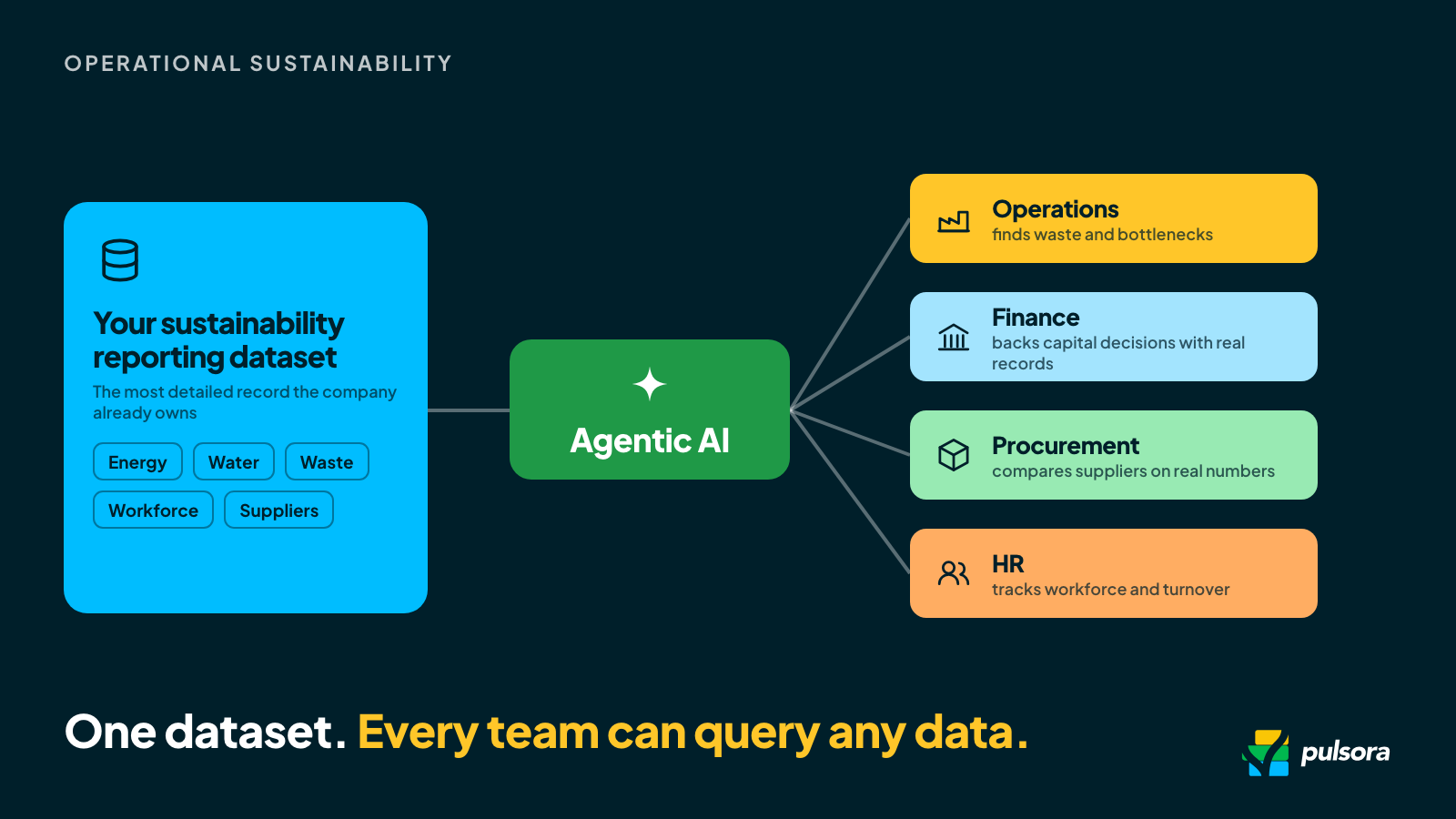
Your ESG disclosure data is one of the most detailed operational records in the company
Think about what is in the dataset you built for the Corporate Sustainability Reporting Directive (CSRD) and your Scope 3 accounting. Energy and water use for each site. Material and waste flows. Workforce activity. Output for each process, and sometimes each product. Supplier data you spent months collecting.
Few other systems in the company store data at this level of detail. Finance sees a cost center. Operations sees output and downtime. The sustainability team sees the meter reading, the invoice behind it, and the emission factor applied to it.
You collected all of that to pass a sustainability audit. The same detail is useful for improving business operations, and most companies never use it that way.
Your compliance dataset stays siloed because it was structured for reporting, not for business intelligence
This data stayed with the sustainability team for a practical reason.
The data was technically available to the company. But only the people who built it could get answers out of it, because you had to understand its structure to ask it anything. Which site rolls up into which business unit. Which emission factor applies to which activity. Where the reporting boundary sits. Get any of that wrong and the answer is wrong, and you would not know it. So the only people who queried the dataset were the people who built it, and they were busy building next year's report.
Say an operations or finance manager wanted to know why one site's costs rose. They could not simply ask the dataset. They had to request the answer from the sustainability team and wait, then receive a number they could not question or explore themselves. So managers outside sustainability stopped asking.
This is now changing. Agentic AI can sit on top of the dataset and take a plain-language question. A manager in operations or finance can ask why a site's costs went up in March and get an answer traced back to the source records, without understanding how the data is built. The data did not change. What changed is that anyone can now get an answer out of it.
Operational sustainability starts by finding wasted spend in data you already collect
Once the data answers plain questions, the first thing it shows is waste.
The data shows where you put resources in and get nothing useful out. One site using more energy per unit than a similar site nearby. A process where material goes in and scrap comes out. A production line drawing power through a shift when it is not making anything. A team spending hours on a task the numbers say adds nothing.
Each of these is a cost line before it is an emission. And you already paid to collect the data that reveals it. The detail operations needs to find waste is the same detail the sustainability team collected to be accurate.
Carbon is no longer the only thing this data is good for. It is one of many useful signals you can act on, and the spending pattern underneath a carbon number is often what changes a decision.
Operations, finance, and procurement can use your ESG records in their own workflows
Once the data answers plain questions, it becomes useful across the company, not just to the sustainability team.
Operations uses it to find waste and bottlenecks: which sites are drifting, where a process loses material, how workforce hours map to output, what a shift pattern costs to run.
Finance uses it when deciding where to spend capital. A business case for a site upgrade is easier to approve when the consumption and cost data behind it traces back to real records.
Procurement uses supplier-level data when choosing suppliers. The same responses you collected for Scope 3 show which supplier is efficient and which one is not.
Each team finds use cases the sustainability team would not have looked for. And each one gives the whole company a reason to invest in keeping the data current, which is a strong argument for the sustainability team to bring to leadership. It is more efficient to collect data centrally and make it available to every department than to have each function build and maintain its own.
Why this matters to sustainability leaders
Standing up AI-first data infrastructure is a real undertaking, and it needs leadership buy-in and budget. That case is much easier to make when the data serves the whole business, not only the sustainability team.
Framed narrowly, better sustainability data is a compliance cost. Framed as a company asset, the same investment improves operations, sharpens capital decisions, and strengthens sourcing. When every department can draw on the raw data, the infrastructure you need to do your own job becomes something the whole company has a stake in funding.
Your operational KPIs already exist inside your ESG data
You do not need to build a new dataset to explore operational and financial questions. The measures that work as both operational and financial signals are already in your ESG records:
- Energy and material use per unit of output.
- Workforce hours against output, by site or line.
- Site-level intensity, so you can compare two plants that should look the same.
- Activity by supplier, so sourcing decisions are based on real numbers.
Interconnected data that is contextualized and accessible to an agentic AI lets almost any question be asked, without starting a new data project each time.
Use ESG data in external claims only when the number can be fully verified
Brand and sales teams will want to use this data first, and this is where to be careful.
A per-product carbon number can support a sales claim only when the number can be fully verified and traced back to its source. When a buyer questions the claim and asks to see how the figure was collected, a number that is fully grounded, with its source and composition attached, satisfies that check. An estimate presented as a firm measurement becomes a problem the moment a buyer or their auditor examines it.
The rule is simple: only use product-level data externally when the number can be fully verified and traced to its source. Internally, an estimate can be a useful signal. Externally, it is a claim you have to defend.
Operational sustainability turns a compliance dataset into a company asset
Built as a cost of compliance, the sustainability dataset sat mostly with one team and was either unusable or shielded off from other departments. Made easy to query, several teams can now use the same records for their own work to improve their processes and results.
The companies that get the most from this do three things:
- Open the data up to operations, finance, and procurement.
- Keep firm rules on which numbers can be used externally.
- Read the data for cost, waste, downtime, and efficiency, as closely as they read it for carbon.
You have already invested in procuring a detailed and verified dataset for sustainability reporting. The next logical step is to centralize that dataset and make it accessible to your other departments through agentic AI, so each one can use it to improve its own operations.
Frequently asked questions
How is operational sustainability different from sustainability reporting?
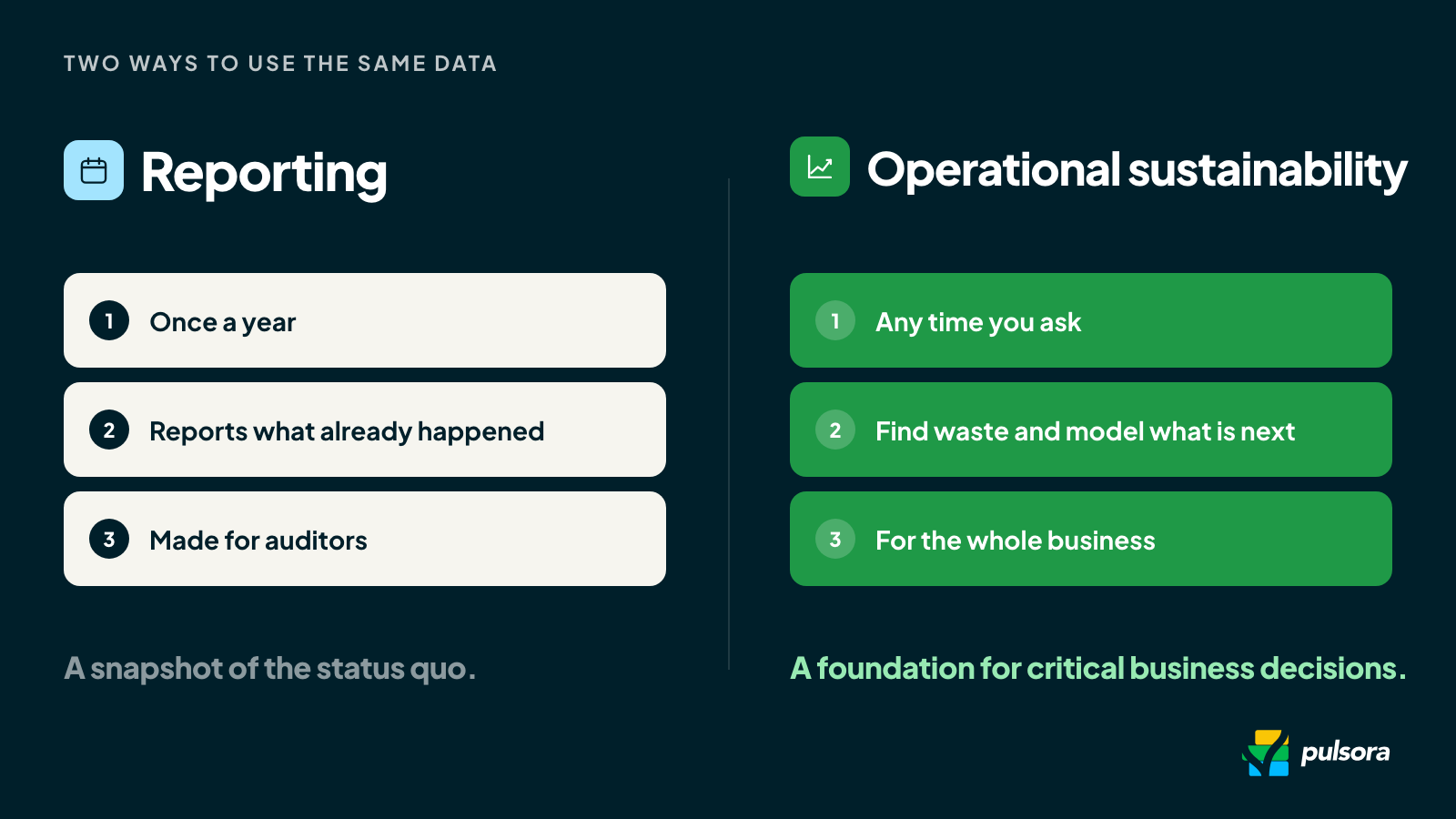
Sustainability reporting is a function that summarizes your current or past status against a framework, for the people who need to be informed. Operational sustainability uses the same records the other way round, to find inefficiencies across cost, waste, workforce, and social and governance issues, to check the status quo more often than once a year, and to model and forecast decisions before you commit to them. The data is the same. What changes is the whole way you use it, not only who reads it.
Who in the company can use ESG data besides the sustainability team?
Once AI makes the data easy to query, teams across the business can use it. Operations can find waste and bottlenecks, finance can guide capital decisions, procurement can compare suppliers, and HR can track how sites perform on turnover and workforce issues. These are examples, not the full list. The more departments that can put a question to the data, the more the same records return.
What KPIs should enterprises track for sustainability and ESG?
Track the measures that double as operational and financial signals across the whole business: energy and material use per unit of output, water use and waste or scrap rates by site, emissions intensity by site, workforce hours against output alongside turnover and safety incidents, supplier response rates and compliance, and training and development hours against retention. Most of these already sit in the records you collect for reporting, so start with the ones you can pull today.
Can per-product carbon data be used in sales claims?
Yes. A per-product carbon number is a real selling point when a customer is choosing between suppliers. Two things keep it safe to use. First, verify the number so no claim rests on an estimate dressed up as a measurement. Second, set it in context. Show how one product's footprint sits against the rest of your range and your total, so a single figure is never read in isolation.
What ESG dashboards do enterprises use?
A useful enterprise ESG dashboard pulls together emissions by scope and site, energy and water use, waste, supplier data, and progress against targets, with the social and governance measures alongside. Feed all of it from the same source that produces your reporting numbers, so the dashboard and the disclosure never disagree. There is one shift to plan for. As AI makes the underlying data queryable in plain language, some of this moves from fixed dashboards to conversational answers, where anyone can ask a question and get a traced response instead of hunting through charts.
Does operational sustainability require new data collection?
Usually not. The detail is already there because reporting required it. What is usually missing is an easy way for someone outside the sustainability team to ask the data a question and get an answer they can trace. That easy way is AI retrieval: an agent that sits on your governed dataset, takes a plain-language question, and returns an answer tied back to the source records. It removes the need to understand how the data is structured, which is what kept the data locked to one team.


