Greenhushing is the practice of companies staying quiet about sustainability work they are doing, and public data is consistent with it. By March 2025, S&P 500 companies mentioned the environment on earnings calls 76% less often than three years earlier, while 83% of companies in a global Deloitte survey reported rising sustainability investment. A clearer EU standard for environmental claims applies from 27 September 2026. It raises the bar for what a claim must prove, which changes how silence can be read. Agentic AI can reduce the manual work of tracing each value in a claim back to its source.
Summary of greenhushing and the evidence behind it. Greenhushing means staying silent about real sustainability progress. Bloomberg Green and Deloitte show talk falling while investment rises, and Directive (EU) 2024/825 raises the bar for claims.
Companies are talking about sustainability far less in public
Bloomberg Green analyzed S&P 500 earnings-call transcripts going back to 2020. It tracked terms including climate change, environmental, social and governance, and clean energy. On average, companies talked about the environment 76% less than they did three years earlier, and mentions peaked at the beginning of 2022 [1].
The Bloomberg Green result describes behavior only. It measures what executives say on calls with investors and analysts, at large companies listed in the United States. The analysis does not tell you what those companies are doing about emissions, and it does not yet tell you what the silence costs them. Earnings calls are also one channel among several. Many of the same companies still publish sustainability reports and regulatory filings.
Companies that go quiet are likely weighing accusations, scrutiny and legal exposure
Companies rarely explain their silence in public. Likely reasons include fear of a greenwashing accusation, political scrutiny, and legal exposure. Each of these pressures is reasonable on its own. A claim that turns out to be inaccurate can draw criticism, so saying less can feel like the careful choice.
Some companies may be retreating from talking about the work while the work itself continues. The next section looks at the evidence for that reading.
Going silent to manage one risk can also create another. When a company that was once open about its progress stops talking, readers can start to wonder what changed. Stopping the conversation can raise doubt by itself, even when the underlying work continues.
Reported sustainability investment keeps rising while public talk falls
The Deloitte 2025 C-suite Sustainability Report surveyed more than 2,100 C-level executives in 27 countries. It found that 83% of companies increased sustainability investment over the past year by more than 5%, and 14% increased it by 20% or more [2].
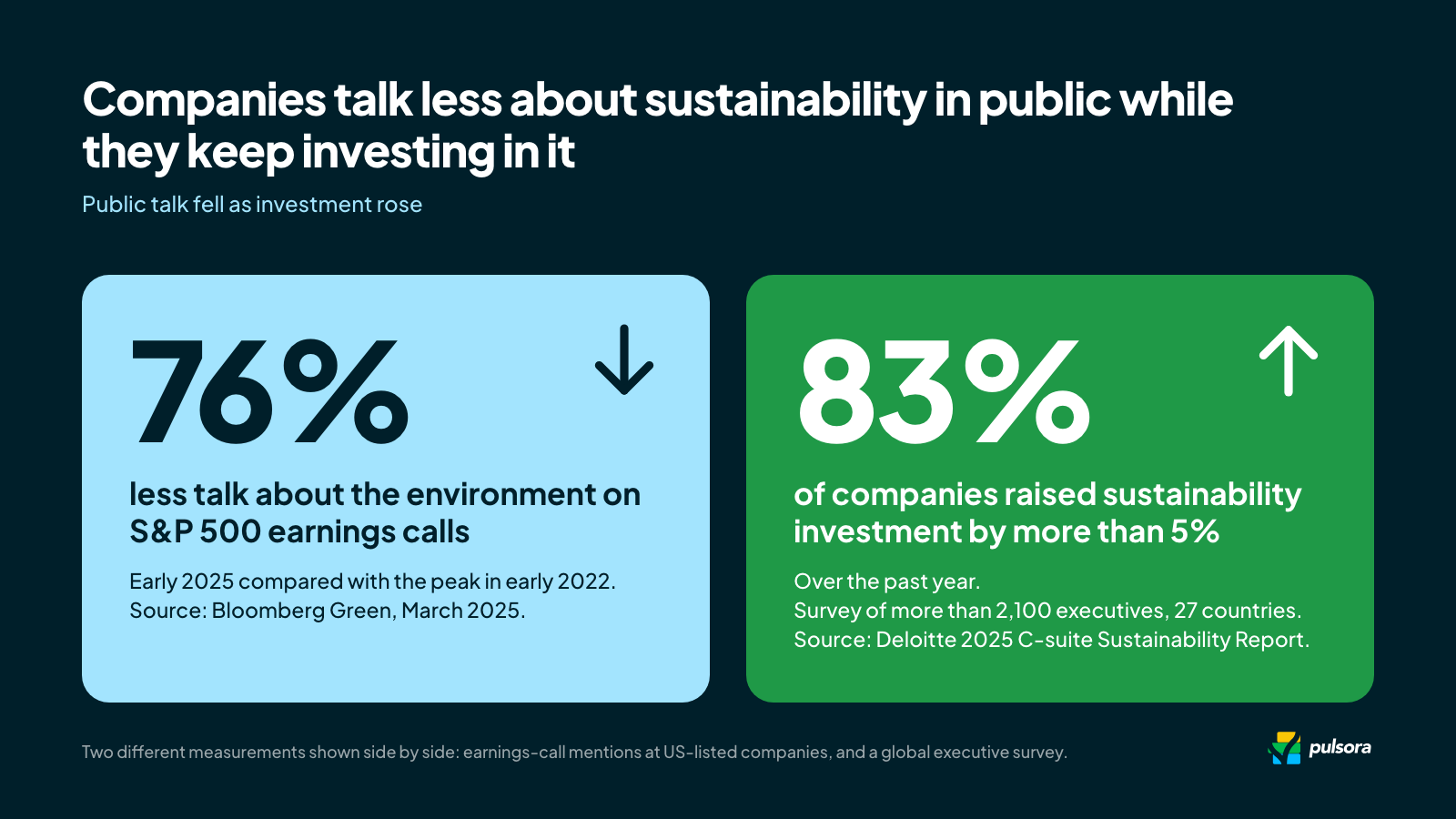
The two sources measure different things and should not be read as one population. Bloomberg Green counted words spoken on earnings calls at S&P 500 companies. Deloitte asked executives around the world what their companies spent. One source covers public communication at large US-listed firms, and the other is a global executive survey of investment.
Spending is an input, and it does not prove results. The two findings also do not show that the companies saying less are the same companies spending more. Read together, they are consistent with a pattern in which some companies keep working on sustainability while saying less about it on the calls investors listen to. Where that happens, investors hear less about work that may still be under way.
Silence spreads between peers, at least among Chinese listed firms
Zhang, Meng and Liu studied greenhushing among Chinese A-share listed firms and found a significant industry peer effect. They measured greenhushing as the gap between a firm's environmental, social and governance rating and the carbon-related language in its corporate social responsibility reports. In their observational data, the authors report that a firm's tendency to stay silent on green issues is strongly driven by how much its industry peers stay silent, and that market competition and environmental regulation both amplify the effect [3].
The study covers Chinese listed firms only. It does not show the same effect in other countries or industries, so the finding is a reason to watch for peer influence in your own sector and not a conclusion about it.
A clearer legal standard for environmental claims changes how silence is read
Directive (EU) 2024/825, Empowering Consumers for the Green Transition, had a transposition deadline of 27 March 2026 and applies from 27 September 2026. The directive is therefore in force now. It targets misleading environmental claims and sustainability labels in business-to-consumer commercial practices [4].
The directive does not force any company to make claims. What it changes is how a claim is judged. Once a rule spells out what a claim must prove, a company that says nothing can start to look like one that lacks the evidence to say anything. Business-to-business companies are not directly covered, although consumer-facing customers may ask them for the same proof.
A stricter standard can also push some companies further into silence, because many consumer-facing claims now come with more risk. The directive does not settle that tension. What it does change is how silence can be read by regulators, customers and investors who now know what a supported claim looks like.
The diagram below sets the two failures side by side.
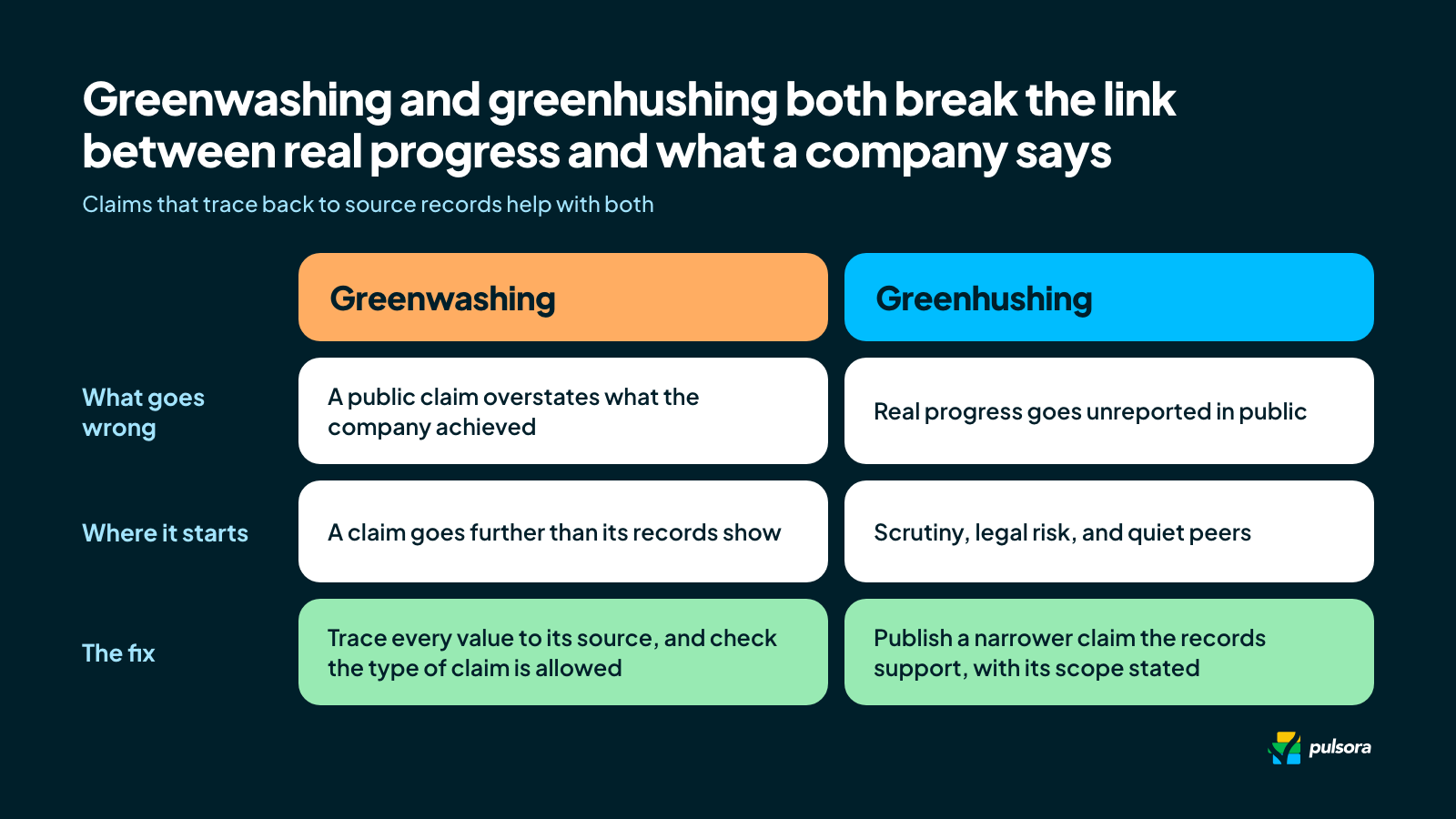
What this means depends on the state of your data. A team with strong internal data can make specific claims now, naming the site, the year and the records behind each value. A team still assessing its data may be better served by a narrower claim than by none, for example one facility and one reporting period, stated with the evidence available today. A narrow claim has to say plainly what it covers, so that one strong site is never presented as the company's overall performance.
Traceable data lets sustainability leaders say what they can prove
Greenwashing and greenhushing look like opposite mistakes, since one overstates progress and the other hides it. Both can involve a gap between what a company achieved and what it can show. Some companies also stay quiet for political or competitive reasons that better records will not change. A public claim is much easier to stand behind when every value in it traces back to its source: the activity data from energy invoices, fuel purchases and procurement records, the data each supplier reported, the emission factor applied to it, and the reporting period it covers. Traceability is the starting point. Each value still has to be accurate, and some types of claim are restricted under the directive however well documented they are. Without that trail, legal and communications teams may judge silence to be the smaller risk.
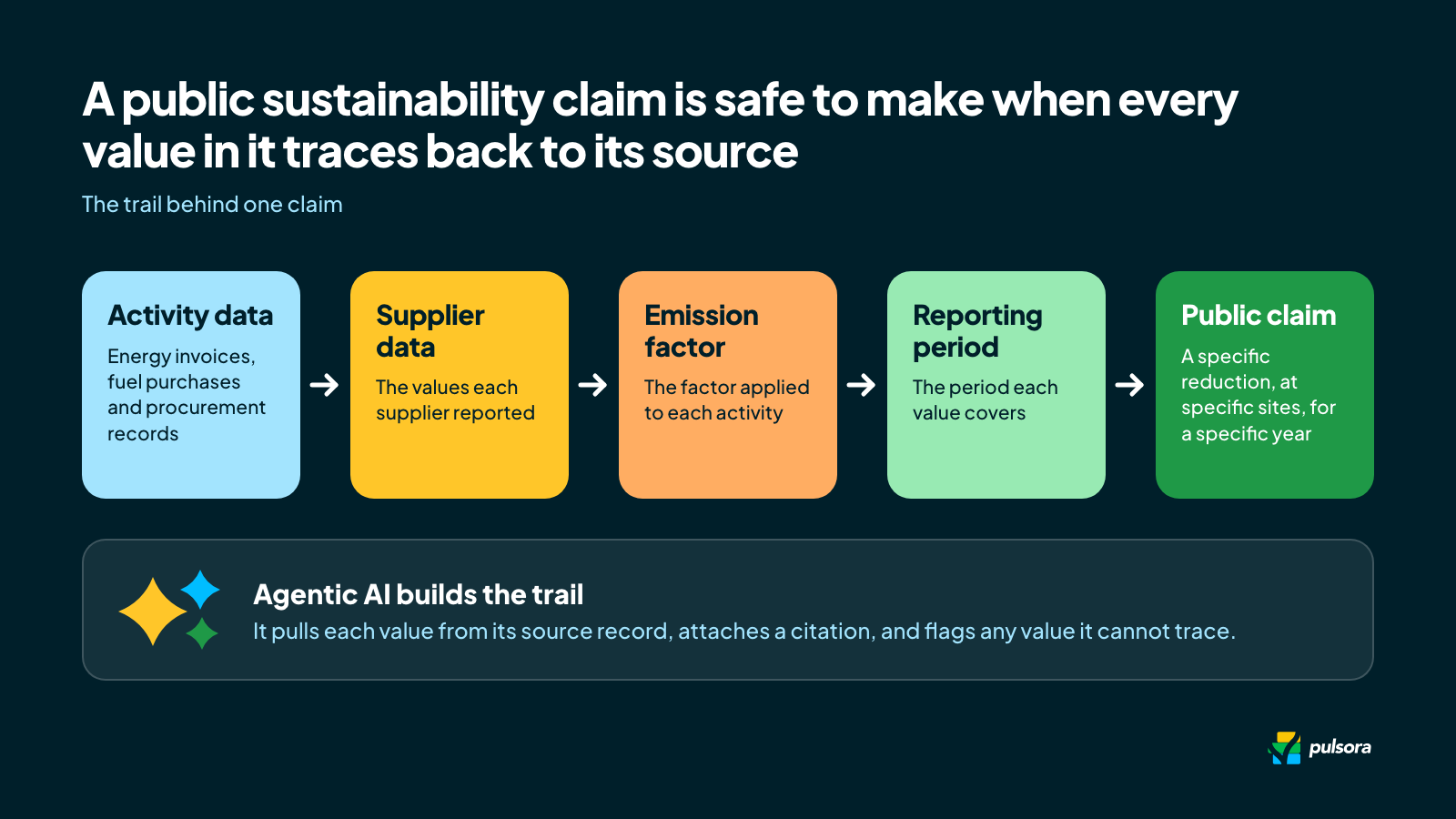
Building that trail by hand for every public claim can take more time than a sustainability team has before a deadline. So claims can go unchecked, or never get made. Agentic AI can reduce how much work that takes. A well-configured agent can pull each value from its source record, attach a citation to it, and flag any value it cannot trace. Your team reviews the flagged gaps first, and still checks that each cited value uses the right period, unit and emission factor.
That makes a narrower, honest claim more practical. A company can state a specific reduction, at specific sites, for a specific year, and show the records behind it. Once that proof is assembled, staying quiet is no longer the only safe choice.
Accuracy matters more than volume, and agentic AI can reduce the work behind it
Nothing in the evidence here says companies should talk more. The evidence points toward saying what the data supports, at whatever scale it supports. A full annual claim might fit one team, and a single well-documented site might fit another. Each version can be honest, as long as it states its scope plainly and gives stakeholders something to check.
Agentic AI can cut the manual work of assembling that proof, so the smaller version depends less on a team finding spare time. So here is a question worth asking this week: which of your sustainability activities could you describe in public today, with a source record for every value, if someone asked to see it?
Frequently asked questions
What is greenhushing?
Greenhushing is a company choosing to say little or nothing about sustainability work it is doing, for reasons such as avoiding criticism. It differs from greenwashing because the problem is under-reporting of real progress, and no false claim is involved.
Is greenhushing illegal the way greenwashing can be?
Silence itself is not a violation under any of the rules cited here. Directive (EU) 2024/825 targets misleading environmental claims and labels in consumer-facing commercial practices, so it governs what a company says [4]. The exposure from silence is indirect, because a clearer standard for claims makes an absence of claims easier to question.
How common is greenhushing right now?
Bloomberg Green measured a 76% drop in environmental mentions on S&P 500 earnings calls between early 2022 and early 2025 [1]. That drop shows far less public talk at large US-listed firms, though it does not show why each company said less. The data runs to early 2025, so it cannot show whether the trend has continued since.
Does greenhushing spread between companies?
In one study of Chinese A-share listed firms, the authors report that a firm's silence was strongly driven by its industry peers' silence, and market competition and environmental regulation amplified that link [3]. The study does not show whether other countries behave the same way.
What replaces silence if overclaiming is not safe either?
A narrower claim that names its scope: one site, one reporting period, and the source records for every value. A claim of that size gives a company something specific to publish now while the rest of its data is still being assessed, provided it is never presented as the company's overall performance.
How can a company tell if it is greenhushing without realizing it?
Compare what your teams track internally with what your company says publicly. Not every internal metric belongs in public. Metrics with strong records behind them, that stakeholders would reasonably expect to see, and that appear nowhere in public are the first place to look, especially if investment in that area has risen.
References
- Bloomberg Green, 27 March 2025, "Climate Talk on S&P 500 Earnings Calls Drops by Three-Quarters." https://www.bloomberg.com/news/articles/2025-03-27/climate-talk-on-s-p-500-earnings-calls-drops-by-three-quarters
- Deloitte, 2025 C-suite Sustainability Report, as reported by ESG Today. https://www.esgtoday.com/83-of-companies-increased-sustainability-investments-over-past-year-deloitte-survey/
- Zhang, Meng and Liu, "Peer effect of corporate greenhushing: evidence from China," Humanities and Social Sciences Communications, vol. 13, article 705, March 2026. https://www.nature.com/articles/s41599-026-07000-w
- Directive (EU) 2024/825 of the European Parliament and of the Council, Empowering Consumers for the Green Transition. https://eur-lex.europa.eu/eli/dir/2024/825/oj/eng


