Climate change is both an environmental issue and a financial one.
Extreme weather events, shifting regulatory landscapes, and the global transition to a low-carbon economy are reshaping the risk profiles of companies across every sector.
Investors, lenders, and other stakeholders need reliable, comparable, forward-looking information to make sound decisions, so that’s exactly what the Task Force on Climate-related Financial Disclosures (TCFD) is designed to provide.
This guide explains what TCFD is, breaks down its four pillars and recommended disclosures, addresses whether TCFD reporting is mandatory, and helps you understand where things stand.
TL;DR
The TCFD framework is built around 11 recommended disclosures across four pillars: governance, strategy, risk management, and metrics & targets. Together, they show how climate-related risks are identified, managed, and translated into financial impact. In the section below, we break down each disclosure so you can understand exactly what needs to be reported, and how it connects back to business performance.
What is The Task Force on Climate-related Financial Disclosures (TCFD)?
Commonly referred to as TCFD, the Task Force on Climate-related Financial Disclosures is a global initiative established in 2015 by the Financial Stability Board (FSB) to develop consistent, comparable disclosures for companies to report on climate-related financial risks and opportunities.
The FSB created the TCFD’s reporting practices in response to growing concern that climate-related financial risks were not being adequately captured or communicated in mainstream financial reporting. Without a common framework, investors and other stakeholders were left without the climate-related financial information they needed to assess corporate resilience and allocate capital effectively.
In 2017, the TCFD released its foundational recommendations, a voluntary framework encouraging organizations to disclose their governance, strategy, risk management, and metrics related to climate change. By the time the TCFD disbanded in 2023, having transferred oversight to the IFRS Foundation, more than 4,000 organizations across 101 jurisdictions had expressed their support.
What are the 4 principles of TCFD?
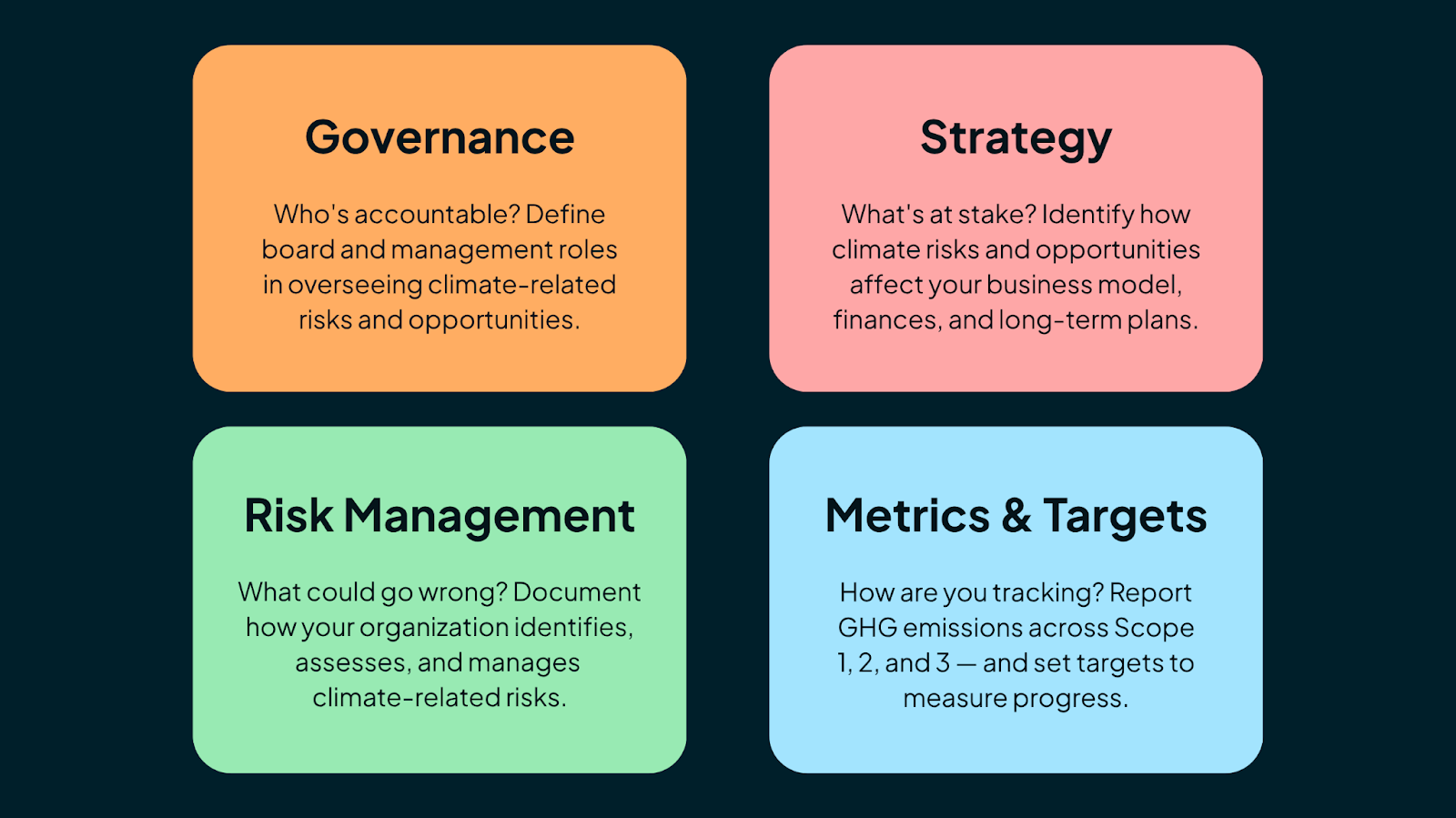
The TCFD framework is organized around four core pillars, each representing a key area of climate-related financial information. These are not isolated disclosure categories. They are interconnected, reflecting how climate risk flows through an organization from board-level governance all the way to quantified performance targets.
Governance
Describes how an organization's board and senior management oversee and address climate-related risks and opportunities. This includes the board's oversight role, the frequency of climate discussions, and management's role in day-to-day risk management processes.
Strategy
Captures the actual and potential impacts of climate-related risks and opportunities on the organization's business model, strategy, and financial planning over the short, medium, and long term. Scenario analysis is a key tool here, helping organizations assess the resilience of their strategy under different climate-related scenarios, including a 2°C or lower pathway.
Risk Management
Explains how the organization identifies, assesses, and manages climate-related risks, and how those processes are integrated into its broader risk management framework. Both transition risks (policy, legal, technology, market, and reputational) and physical risks (chronic and acute) should be addressed.
Metrics & Targets
Discloses the metrics and targets used to assess and manage relevant climate-related risks and opportunities. This includes Scope 1, Scope 2, and (where relevant) Scope 3 greenhouse gas (GHG) emissions, along with emissions reduction targets and progress against them.
What are the TCFD reporting requirements and recommended disclosures?
The TCFD framework centers on 11 recommended disclosures spread across its four pillars. These form the backbone of TCFD-aligned reporting and provide the structure most organizations use when preparing climate-related financial disclosures.
Governance
a) Board's oversight of climate-related risks and opportunities
b) Management's role in assessing and managing climate-related risks and opportunities
Strategy
a) Climate-related risks and opportunities identified over short, medium, and long term
b) Impact on the organization's businesses, strategy, and financial planning
c) Resilience of the organization's strategy, using scenario analysis
Risk Management
a) Organization's processes for identifying and assessing climate-related risks
b) Organization's processes for managing climate-related risks
c) How those processes are integrated into the organization's overall risk management
Metrics & Targets
a) Metrics used to assess climate-related risks and opportunities
b) Scope 1, Scope 2, and Scope 3 GHG emissions
c) Targets used to manage climate-related risks and opportunities, and performance against them
These recommended disclosures are designed to be useful to a wide audience, from asset managers and lenders making capital allocation decisions, to regulators monitoring systemic risk across financial markets.
Importantly, the TCFD recommendations are principles-based rather than prescriptive. Organizations are encouraged to disclose information that is material to their specific circumstances, considering the nature of their value chain, supply chain, business model, and exposure to transition plans.
| Pillar | Recommended disclosure | What to disclose |
|---|---|---|
| Governance | Board oversight | Describe the board’s oversight of climate-related risks and opportunities. |
| Governance | Management’s role | Explain management’s role in assessing and managing climate-related risks and opportunities. |
| Strategy | Climate-related risks and opportunities | Outline the climate-related risks and opportunities identified over the short, medium, and long term. |
| Strategy | Business impact | Describe the impact of climate-related risks and opportunities on the organization’s businesses, strategy, and financial planning. |
| Strategy | Scenario analysis | Describe the resilience of the organization’s strategy, taking into consideration different climate-related scenarios. |
| Risk Management | Risk identification and assessment | Explain the processes used to identify and assess climate-related risks. |
| Risk Management | Risk management processes | Explain the processes used to manage climate-related risks. |
| Risk Management | Integration into overall risk management | Describe how climate-related risk processes are integrated into the organization’s overall risk management framework. |
| Metrics & Targets | Metrics used | Disclose the metrics used to assess climate-related risks and opportunities in line with the organization’s strategy and risk management process. |
| Metrics & Targets | Scope 1, 2, and 3 emissions | Disclose Scope 1, Scope 2, and, where appropriate, Scope 3 greenhouse gas emissions and the related risks. |
| Metrics & Targets | Targets and performance | Describe the targets used to manage climate-related risks and opportunities and report performance against those targets. |
Is TCFD a mandatory reporting framework?
Originally, TCFD reporting was voluntary. However, the landscape has shifted considerably. Several jurisdictions have either mandated or are in the process of requiring TCFD-aligned disclosures:
- The United Kingdom made TCFD-aligned disclosures mandatory for large public companies and financial institutions starting in 2022.
- New Zealand was among the first countries to legislate mandatory TCFD reporting for the financial sector.
- The European Union's Corporate Sustainability Reporting Directive (CSRD) incorporates TCFD-aligned principles within its broader requirements.
- Canada, Australia, Singapore, Japan, and other jurisdictions are advancing similar mandatory frameworks.
- In the United States, the SEC's climate disclosure rules, while subject to ongoing legal challenges, also draw heavily from TCFD's structure.
Even where TCFD reporting remains technically voluntary, the framework has become a de facto standard. Institutional investors, major asset managers, and sustainability rating agencies routinely request or expect TCFD-aligned disclosures as part of corporate reporting and ESG due diligence.
What are the benefits of supporting the TCFD recommendations?
Organizations that adopt TCFD recommendations stand to gain meaningful advantages beyond regulatory compliance:
Investor confidence and access to capital: Transparent climate-related financial information helps investors assess risk and supports more efficient capital allocation decisions.
Improved internal risk management: The TCFD process forces organizations to identify and integrate climate-related opportunities into their strategic planning and risk management processes, often revealing exposures that were not previously visible.
Stakeholder trust: Consistent, comparable disclosures build credibility with stakeholders, from customers and employees to regulators and the broader financial market.
Strategic resilience: Scenario analysis, a cornerstone of TCFD, helps leadership teams stress-test their strategies against a range of climate-related futures, supporting more durable decision-making.
Alignment with emerging standards: TCFD provides a foundation that aligns closely with IFRS S1 and IFRS S2, streamlining compliance with evolving global disclosure standards.
Why is TCFD reporting important?
Climate-related risks are increasingly material to business performance. Physical risks, from flooding, drought, and extreme weather events, can disrupt operations, damage assets, and interrupt supply chains. Transition risks, shifts in policy, technology, and market preferences as economies move toward a low-carbon economy, can affect revenue models, cost structures, and competitive positioning.
TCFD reporting matters because it translates these risks into the language of financial markets. It connects the dots between climate change and financial impact, enabling investors, lenders, and insurers to price risk accurately and direct capital toward more resilient businesses. Without this information, financial markets cannot function efficiently in a climate-constrained world.
From an organizational standpoint, TCFD reporting drives better internal governance. When boards and management teams are asked to disclose their oversight processes and risk management frameworks, it creates accountability, and often accelerates action.
Where can I find TCFD guidance?
While the TCFD itself disbanded in October 2023, its foundational recommendations, guidance documents, and supplemental materials remain publicly available and continue to serve as the primary reference for TCFD-aligned reporting. Key resources include:
- The TCFD's Final Status Report (2023), summarizing progress and transferring oversight to the IFRS Foundation
- TCFD implementation guidance for specific sectors, including financial institutions, energy, transportation, agriculture, and materials companies
- The IFRS Foundation's website, which now houses TCFD-aligned standards through IFRS S2
- CDP's reporting platform, which incorporates TCFD-aligned questions as part of its disclosure framework
- National regulators and stock exchanges in relevant jurisdictions, which may publish additional implementation guidance
What are IFRS S1 and IFRS S2?
When the TCFD disbanded, the International Sustainability Standards Board (ISSB), established by the IFRS Foundation, assumed responsibility for global climate-related disclosure standards. The ISSB released two foundational standards in 2023:
IFRS S1
IFRS S1 establishes general requirements for disclosing sustainability-related financial information across a company's full value chain.
IFRS S2
IFRS S2 specifically addresses climate-related disclosures and is explicitly built on TCFD's framework, adopting the same four-pillar structure (Governance, Strategy, Risk Management, and Metrics & Targets) and expanding on the recommended disclosures.
For organizations that have invested in TCFD-aligned reporting, the transition to IFRS S2 is relatively straightforward. The TCFD framework is, in effect, the foundation on which the global baseline for climate disclosure now rests. Companies operating across multiple jurisdictions should also be aware that the CSRD and other regional frameworks may have additional or diverging requirements.
How do companies implement TCFD recommendations?
Implementing TCFD recommendations effectively requires cross-functional coordination: sustainability, finance, risk, legal, and strategy teams all need to be involved.
An approach to implementing TCFD recommendations:
Conduct a gap assessment
Evaluate your current disclosures against the 11 recommended disclosures to identify gaps in governance documentation, risk management processes, and metrics.
Engage leadership
TCFD requires demonstrating board-level oversight. Ensure your governance structures formally integrate climate-related risk and document the board's oversight role.
Identify material climate-related risks and opportunities
Map your exposure to transition risks and physical risks across your business model, supply chain, and value chain over different time horizons.
Run scenario analysis
Use established scenarios (such as IEA or IPCC pathways) to assess the resilience of your strategy. This is often the most challenging, and most valuable, element of the TCFD process.
Establish and track metrics
Quantify your GHG emissions (Scope 1, 2, and 3), set emissions reduction targets, and track performance with consistent methodology year over year.
Integrate into financial filings
Effective disclosures for TCFD belong in mainstream financial reports, annual reports, regulatory filings, not solely in standalone sustainability reports. This signals to investors that climate risk is being treated as financially material.
Use technology to streamline the process
ESG data management platforms like Pulsora help organizations collect, validate, and report climate-related data efficiently, reducing manual effort and improving comparability and auditability across reporting cycles.
Where TCFD stands currently
TCFD's influence has never been greater, even after its formal dissolution. The ISSB's IFRS S2 standard is now being adopted or referenced in mandatory disclosure regimes across dozens of jurisdictions, and the pace has accelerated. As of 2026, 36 jurisdictions have adopted or are actively finalizing steps to introduce IFRS Sustainability Disclosure Standards into their regulatory frameworks.
Several notable developments have landed since 2025. In June 2025, the UK Government released its exposure draft for UK Sustainability Reporting Standards (UK SRS S1 and S2), with mandatory reporting expected for periods beginning on or after January 1, 2026.
In December 2025, the ISSB also issued amendments to the greenhouse gas emissions disclosure requirements within IFRS S2, aimed at reducing complexity and the risk of duplicative reporting during the implementation phase. IFRS Foundation In the US, the SEC's federal climate disclosure rule was withdrawn following prolonged litigation, leaving no federal mandate, though California's Climate-Related Financial Risk Act (SB 261), which references TCFD alignment, had an initial deadline of January 2026, with enforcement currently paused pending a constitutional challenge.
For companies operating globally, climate-related financial disclosures are no longer a voluntary exercise in most major markets. The question is no longer whether to report, but how to report efficiently and credibly across multiple overlapping frameworks. A strong TCFD-aligned reporting foundation, now essentially synonymous with IFRS S2, remains the most effective starting point.
How to choose the right software for TCFD
As climate-related disclosure requirements expand, the right ESG data management platform can mean the difference between a reporting process that's reactive and burdensome versus one that's strategic and efficient. When evaluating solutions, consider:
- Framework coverage: Does the platform support TCFD, IFRS S2, CSRD, GRI, and other frameworks your organization may be subject to?
- Data quality and auditability: Can the platform capture, validate, and document data in a way that would hold up to external assurance?
- Workflow management: Does it support collaboration across finance, sustainability, legal, and operations teams?
- Scalability: Can it handle Scope 3 emissions data across a complex value chain or supply chain?
- Integration: Does it connect to your existing financial systems, ERP, or data infrastructure?
Pulsora is purpose-built for enterprise sustainability teams navigating complex, overlapping reporting requirements. Our platform maps data collection to specific disclosure requirements, including the TCFD's four pillars and 11 recommended disclosures, so your team can report with confidence and efficiency.
Frequently asked questions about TCFD
What does TCFD stand for?
TCFD stands for Task Force on Climate-related Financial Disclosures. It was established in 2015 by the Financial Stability Board (FSB) to develop a consistent global framework for companies to disclose climate-related issues.
What are the four pillars of the TCFD framework?
The TCFD framework is organized around four core pillars: Governance, Strategy, Risk Management, and Metrics & Targets. Together, they trace how climate risk flows through an organization, from board-level oversight down to quantified emissions data and performance targets.
What are the 11 recommended disclosures?
Each of the four pillars has a set of recommended disclosures, 11 in total. They cover the board's oversight role, management's responsibilities, how climate risks and opportunities affect strategy and financial planning, how risks are identified and managed, and what metrics and GHG emissions targets the organization reports against.
Is TCFD reporting mandatory?
It depends on your jurisdiction. TCFD-aligned disclosure started as voluntary but is now mandatory or actively being legislated in many major markets, including the UK, Australia, Singapore, Japan, and others. Even where it remains technically voluntary, institutional investors and ESG rating agencies broadly expect it.
Does TCFD still exist?
The TCFD formally disbanded in October 2023, having completed its mandate. Its recommendations were fully incorporated into IFRS S2, published by the International Sustainability Standards Board (ISSB). Companies applying IFRS S2 automatically satisfy the TCFD recommendations.
What is the difference between TCFD and IFRS S2?
IFRS S2 is built directly on TCFD's four-pillar structure and 11 recommended disclosures, but goes further, adding industry-specific metrics, additional Scope 3 emissions requirements, and requirements to connect climate disclosures to financial statements. Think of IFRS S2 as TCFD's successor and expansion, not a replacement with a different philosophy.
How does TCFD relate to CSRD?
The EU's Corporate Sustainability Reporting Directive (CSRD) shares TCFD's underlying logic but is broader in scope and uses a double materiality lens, meaning companies must report both how climate affects their finances and how their business affects the climate. Companies subject to CSRD will find significant overlap with TCFD, but the CSRD's requirements are more extensive.
What are the benefits of TCFD reporting?
Beyond regulatory compliance, TCFD reporting builds investor confidence, improves internal risk visibility, strengthens stakeholder trust, and forces the kind of scenario analysis that makes long-term strategy more resilient. It also provides a strong foundation for transitioning to IFRS S2 and other emerging standards.
Why does TCFD reporting matter?
Climate-related risks, both physical risks like extreme weather and transition risks like policy shifts, are increasingly material to financial performance. TCFD reporting translates those risks into the language of financial markets, helping investors price risk accurately and direct capital toward more resilient businesses.
How do I get started with TCFD reporting?
Start with a gap assessment against the 11 recommended disclosures, get board-level governance documented, identify your material climate-related risks and opportunities, and establish your GHG emissions baseline across Scope 1, 2, and 3. From there, scenario analysis and target-setting build on that foundation. An ESG data management platform like Pulsora can streamline data collection, workflow, and disclosure output across TCFD, IFRS S2, and other frameworks.


