Run several AI agents on your sustainability data and each one can end up working from its own copy of it. Each also makes its own assumptions about how that data fits together. The result is agents that disagree, numbers no one can trace, and extra manual cleanup to reconcile them. The way out is governance. A single source of truth every agent reads from, defined limits on what each agent can read or change, a set order for how they hand work along, and an audit trail on every step. Build that foundation first, then add agents.
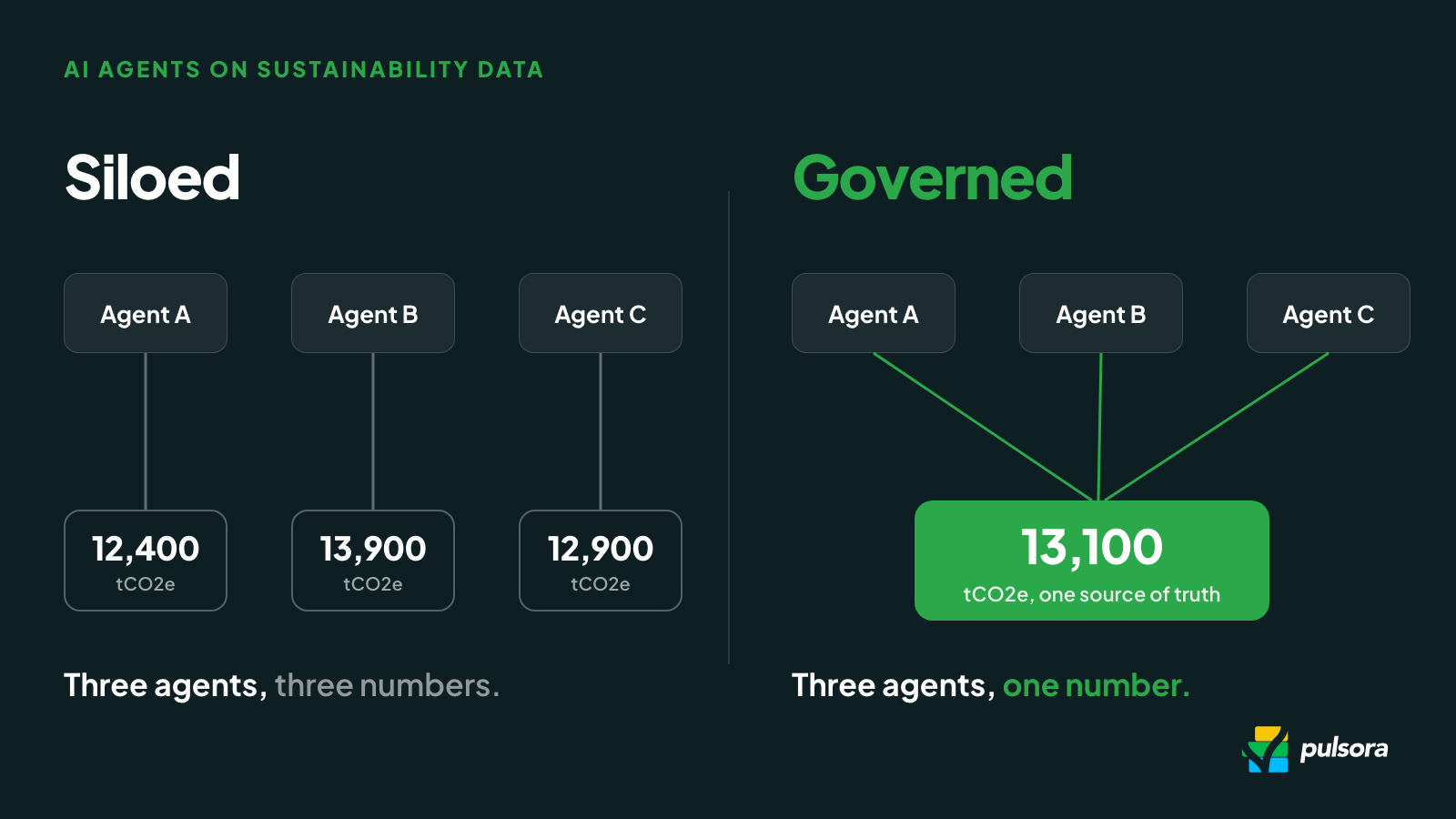
How teams end up with too many disconnected agents
Each agent starts as a sensible, local decision. Procurement stands one up to clean supplier data. Facilities builds another for energy meters. Reporting adds a third to draft the disclosure. Each is quick to build and useful on its own.
None of them was designed to share. A year later a dozen of them run side by side, each on its own copy of the data, and no one owns how they connect. The head of sustainability inherits a set of tools that cannot agree on a number and cannot be maintained without a specialist for each one.
Sprawl builds up from many small, sensible decisions, without anyone choosing it.
Why two agents give different numbers from the same data
An agent has to know how your data connects before it can answer. Which facility rolls up into which business unit. Which emission factor applies to which activity. Who owns the number that feeds the disclosure. When you do not define those relationships, the agent infers them, and inference is where the trouble tends to start.
Here is a simple version. Two business units buy from the same supplier. One agent counts the supplier's emissions once, under the unit that owns the contract. Another counts them under both units. Same supplier data, two different Scope 3 totals. Neither agent is broken. They were just never told how to attribute the supplier.
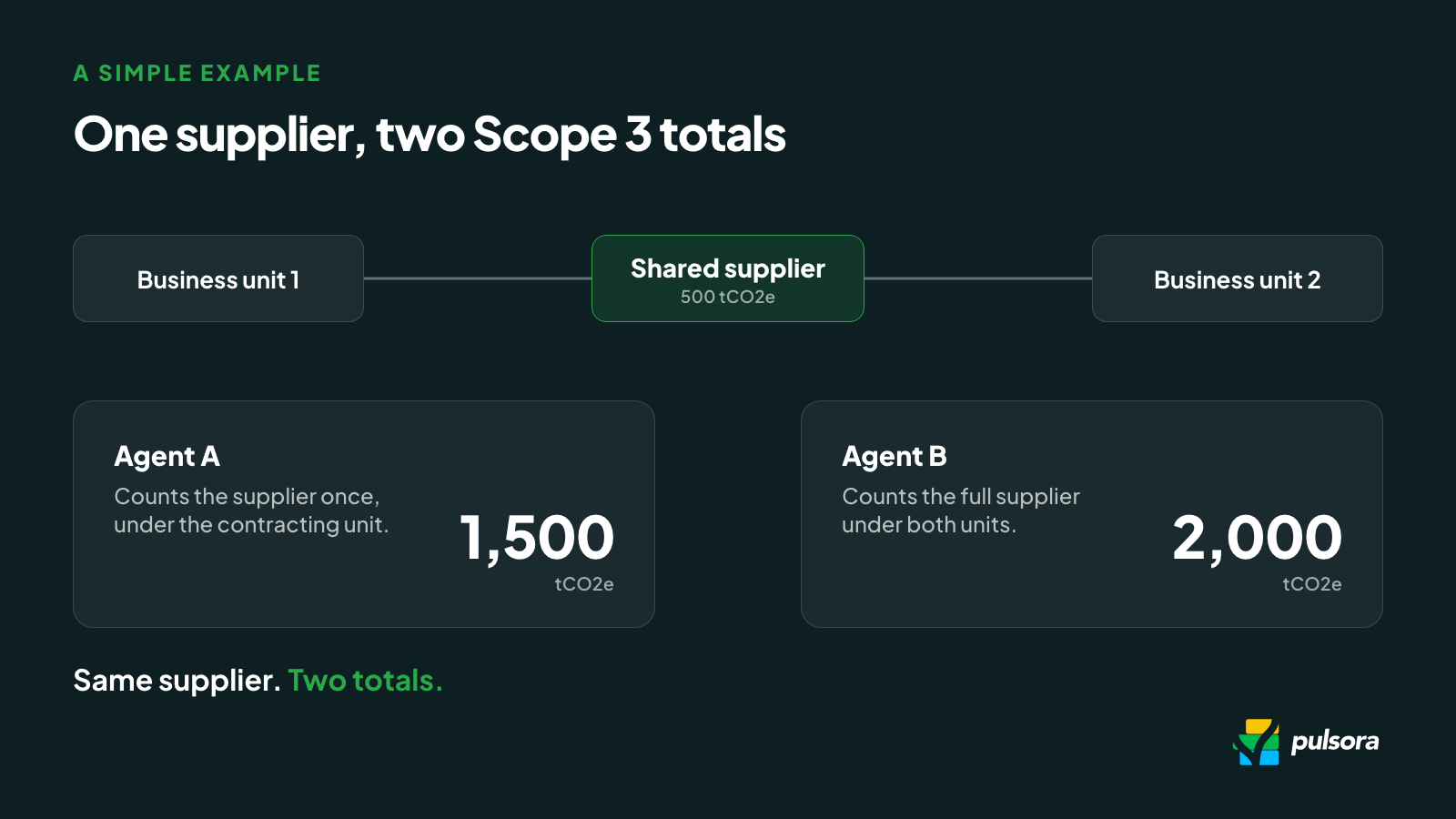
Two agents inferring the same relationships in slightly different ways will produce slightly different answers. In sustainability that shows up as two Scope 3 figures for the same spend category, built from the same records. Each looks defensible on its own. Neither can be traced back to an agreed set of rules. When an assurer asks why they differ, you cannot show which one is right.
The fix is to define the data relationships once, in one unified place both agents read from, so the answer comes out the same whoever asks. A smarter model does not solve this on its own.
How to tell if your agents are siloed
You can tell the difference without opening the code:
- Ask two agents for the same Scope 3 figure and the totals match to the tonne.
- Correct one emission factor at the source, and every agent's next answer reflects it without a manual re-run.
- Click any number in a report and it resolves to the exact records and factor behind it.
When the data is siloed, you see the opposite:
- Two agents disagree on the same figure often enough that you check both before trusting either.
- Every reporting cycle ends with someone reconciling the agents by hand before anything can go out.
- A number gets questioned and no one can say which agent produced it, or what it was built from.
If two or more of those match your setup, the problem sits in the foundation, not in any single agent. Adding a better agent on top will not fix a shared-data problem.
The four parts of agent governance

Governing agents comes down to four things, and none of them is glamorous.
A shared catalog. Every agent reads from and writes to one defined dataset. The relationships in that data are set in advance, not left for each agent to guess.
Access control. Each agent is limited to the data its job requires. A drafting agent should not be able to overwrite a source emission factor. A tight scope also keeps each agent's answers closer to its data, which is one of the simplest ways to cut hallucinations.
Orchestration. Agents work in a planned sequence and pass results to each other on purpose, at a set point rather than whenever each one happens to finish. A pre-audit check runs before the disclosure draft rather than afterward, for example.
An audit trail. Every step is logged, and every number carries a citation back to its source. When an assurer asks how a figure was produced, the trail answers.
If you cannot show which agent touched a number and where it came from, you have output without governance.
This is closer to a necessity than a nice-to-have. Without it, every AI answer gets double- and triple-checked by hand, and the agents add work instead of removing it. You end up paying twice, once for the AI and once for the people cleaning up after it, and the case for using AI at all starts to weaken. A governed foundation is what lets these agents take work off the team rather than pile more on.
Five checks before you add another agent
Run the next agent through five questions before you switch it on.
- Does it read from the shared source of truth, or from a copy of its own?
- Are the data relationships it uses defined for it, or left for it to infer?
- Who is allowed to change what it produces, and is that change logged?
- Does it hand off to and from other agents in a set order?
- Can you trace any number it outputs back to source records?
If an agent fails two or more of these five, it adds work rather than removing it. And your people have to clean up after it. A new agent is only worth switching on if it takes work off the team.
FAQ
What does audit-ready data governance mean for AI agents in sustainability?
Every number an agent produces can be traced to its source records and the factor behind it, with each step logged. For a sustainability team, that is the line between an agent's answer you can put in a CSRD or Scope 3 disclosure and one you cannot defend to an assurer.
How can you trust the numbers from governed AI agents?
You can trust them as far as you can trace them. Governed agents on a shared dataset put a citation on every figure, so an assurer can follow it; siloed agents give you a fast number you cannot defend.
How do you stop two AI agents from reporting different emissions numbers?
Give them one defined dataset with the relationships set in advance, so neither has to infer how facilities, factors, and roll-ups connect. Agreed once, the same question returns the same figure whichever agent answers.
What do sustainability teams need before running several AI agents together?
One source of truth, defined data relationships, access controls, and an audit trail: the shared foundation that turns separate agents into governed ones. Without it, each new agent adds reconciliation work.
How many AI agents does an enterprise sustainability team need?
As few as cover the distinct jobs, data collection, pre-audit, decarbonization modeling, disclosure drafting, all sharing one governed data layer. The number that causes trouble is the one where a new agent runs on its own copy of the data and starts producing figures no one can reconcile.
Will interconnected AI agents replace sustainability teams?
No. They take the manual data-wrangling off the team and shift it toward checking, deciding, and acting. The judgment, and the accountability for the numbers, remains with people.


