AI has become good at producing answers, but it’s still bad at understanding reality and context those answers live in.
Nowhere is that gap more visible than in sustainability.
Sustainability data is not self-contained. An emissions number only has meaning when you understand where it came from, which boundary it belongs to, what assumptions shaped it, how it maps to regulations, and whether it can be trusted. Strip away that context, and AI can summarize, but it can’t reason.
This is the problem sustainability context graphs are designed to solve.
From disconnected data to connected meaning
A sustainability context graph is not a dashboard, a data lake, or a retrieval layer. It is a structured representation of how sustainability actually works inside an enterprise.
It connects:
- Organizational entities and boundaries
- Operational and value-chain activity data
- Regulatory and disclosure requirements
- Methodologies, emission factors, and assumptions
- Workflow decisions, approvals, and revisions
- Historical context that persists across reporting cycles
What matters is not just the data, but the relationships between it. This is what allows AI to move beyond pattern matching and into understanding.
What a sustainability context graph looks like in practice
At a high level, this diagram captures the core idea behind a sustainability context graph: sustainability intelligence does not live in individual data points, but in the relationships between them.
Emissions are connected to activities → activities are connected to assets and suppliers → suppliers are connected to risk, regulation, and geography → regulations are connected to disclosures, assurance, and decision-making.
What matters is not any single node in the graph, but how meaning emerges from the connections. This is the conceptual breakthrough that makes AI viable in sustainability.
How Pulsora builds on this foundation
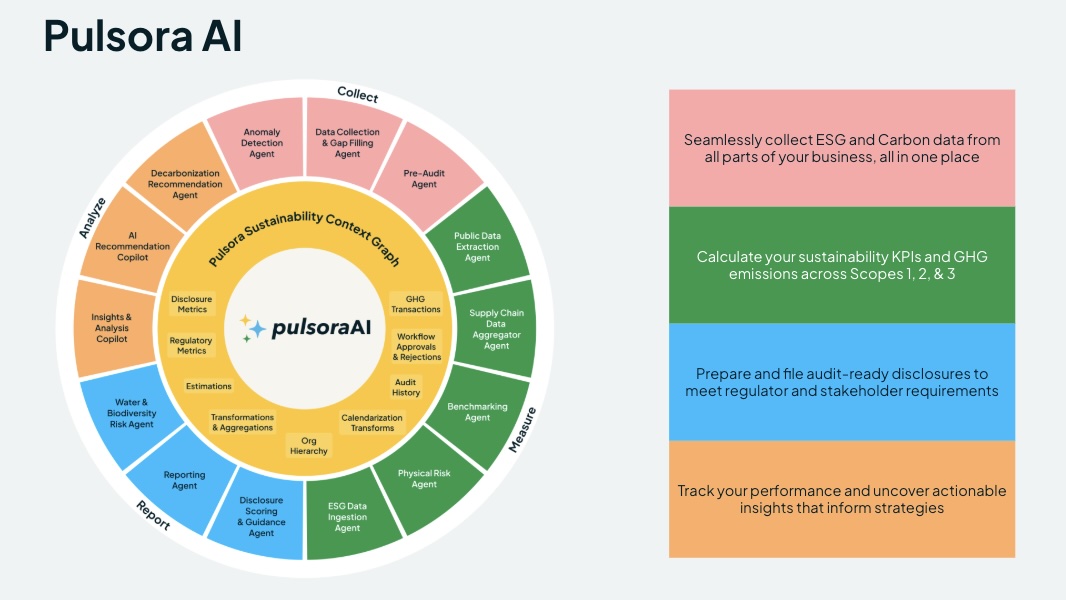
Pulsora’s platform is built around this exact model but extends it into a production-grade, enterprise-ready system.
The context graph is not an abstraction or a visualization layer. It is the core of how the product operates.
In Pulsora, the sustainability context graph continuously connects:
- Organizational hierarchies and reporting boundaries
- Operational and value-chain activity data
- Calculation logic, emission factors, and assumptions
- Regulatory and voluntary disclosure requirements
- Workflow decisions, approvals, and revisions
- Historical audit context that persists across cycles
This depth matters because sustainability decisions are rarely made in isolation. A change in one part of the system, be it supplier behavior, boundary definitions, or regulatory interpretation, has downstream effects everywhere else.
By encoding these relationships directly into the platform, Pulsora allows AI to reason within sustainability reality rather than around it.
Why this changes what AI can safely do
Most AI systems operate on static data inputs. They answer questions based on whatever text or data is retrieved at the moment a prompt is issued.
A context-graph-driven system behaves differently.
Because the graph preserves history, provenance, and intent, AI can explain why an insight exists and understand how current data differs from prior periods and assumptions.
AI will also flag inconsistencies based on context, not just thresholds alone, to support decisions that can be audited, revisited, and trusted.
The difference between visualization and intelligence
Many platforms can draw a diagram that resembles a context graph.
Very few can operationalize it.
The difference is whether the graph is descriptive (a snapshot of relationships), or functional (the system through which data flows, decisions are made, and intelligence compounds)
Pulsora’s sustainability context graph is functional by design. It is the substrate that enables agents, analytics, reporting, and decision support to work together coherently over time.
Why AI needs context to be useful in sustainability
Generic AI tools operate on text and probabilities. They perform well when questions are simple and stakes are low. Sustainability requires the opposite.
It is judgment-heavy, audit-exposed, and constantly changing. Decisions ripple across operations, finance, risk, and reputation. AI cannot safely operate in this environment unless it is grounded in a system that preserves provenance, intent, and trust.
A context graph provides that grounding.
When AI operates on top of a sustainability context graph, it can:
- Interpret emissions changes in relation to operational or supplier shifts
- Surface risks based on how issues compound across climate, water, and operations
- Adapt to regulatory changes without rebuilding logic from scratch
- Explain why an insight exists, not just what it is
This intelligence does not come from the model alone. It comes from the structure underneath it.
Why this changes the sustainability playbook
Most sustainability systems were built to support reporting cycles. They answer questions after the fact.
Context-driven systems support decisions in real time.
They allow sustainability teams and leaders to ask:
- Why is this happening?
- What changed since last quarter or last year?
- What assumptions are driving this outcome?
- What should we do next?
That shift – from static reporting to continuous reasoning – is what makes AI finally matter in sustainability.
The future belongs to context-first sustainability platforms
As regulations, expectations, and risks continue to evolve, sustainability intelligence cannot be rebuilt every year. It has to compound year over year.
Context graphs make that possible by preserving meaning over time so every reporting cycle strengthens the system rather than resetting it.
This is why sustainability context graphs are quickly becoming the foundation for the next generation of AI-driven sustainability platforms. They don’t just make reporting faster, but because they make better decisions possible.


