Short answer: AI sustainability decision-making means assessing what each option would do, on emissions and other impacts, before a team commits to it. Sustainability AI can connect supplier, operational and regulatory data, in minutes instead of weeks in the best case once the data sources are connected, so sustainability leaders can compare options while the choice can still change. The judgment, the risk and the responsibility stay with the team.
Summary of the three steps: A team models its options, ranks them by impact across emissions and other sustainability results using weights it sets, and tests the ranking against data it can trace to a source before it commits.
Reporting will always matter. Assessing outcomes before they happen is what has been missing. Two examples show the pattern. A company picks a supplier and learns that supplier's emissions a year later, when the contract is already signed. Another company weighs air conditioning for its plants and reaches the right answer only after it connects data that sits in separate departments. Both stories end the same way: the information arrived after the choice.
Sustainability data often arrives after the decision is already made
Much of a company's sustainability data is used to understand and report what has already happened. A report tells a sustainability leader the emissions, compliance status, governance and cost of last year's choices. It can be accurate and still be late. By the time the data exists, the contract is signed, the facility is built or the product has shipped.
Sustainability teams have always made decisions from some kind of forecast. A cost estimate, a rough sense of impact and a judgment call about what a choice would mean later all shaped the decision. What has changed is what the forecast is built on. Sustainability AI pulls values from their source records, so teams can build projections from real records instead of assumptions alone, although a projection can still be wrong.
Teams also ask different questions. After a decision, the question is "what did this choice do to our emissions, our compliance position and our people?" Before it, the question is "which of these choices makes the biggest difference across all three?" Teams have always asked these questions to improve the next cycle. Answered before resources are committed, the same questions can change the current one.
This connects to treating sustainability as a business decision problem as well as a reporting task.
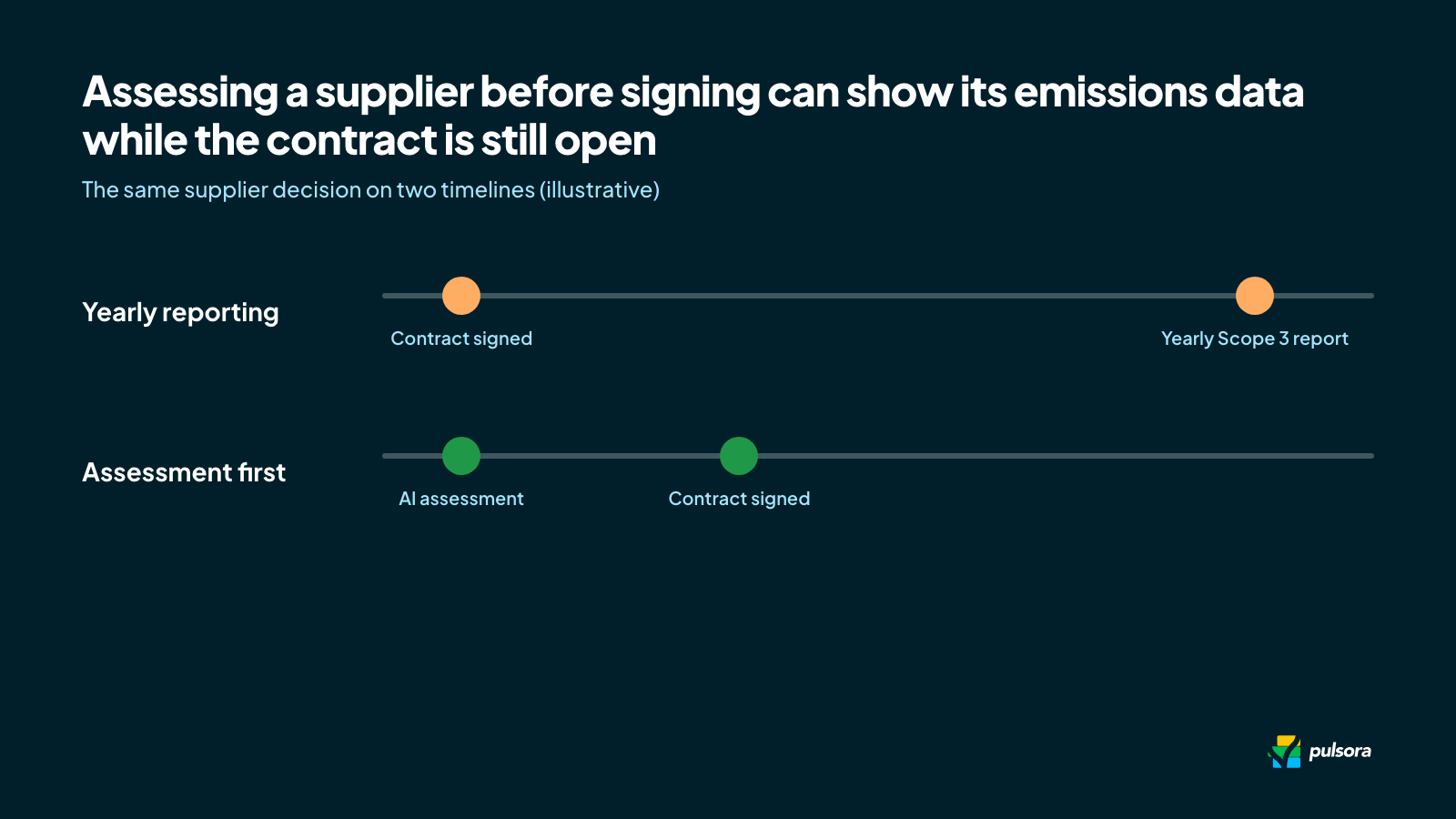
Supplier emissions often surface a year after the contract is signed
Sourcing and sustainability teams change suppliers for a material or service, usually because of cost, capacity or reliability. Several suppliers can look good, each with its own price, location and network of sub-suppliers, energy sources and shipping routes.
Procurement teams have usually picked suppliers on price and contract terms, often the lowest bid. The emissions from a supplier's upstream chain often reached the team only through yearly Scope 3 reporting. If the chosen supplier's chain was much more carbon-intensive than the alternatives, a team could go almost a year without knowing. By then, renegotiating the contract could be too costly to justify. Those decisions were reasonable given the information available at the time.
Today, a team can assess emissions at the moment of decision. Before a contract is signed, a team can check each supplier for emissions, compliance risk and price. The review can reach beyond the first tier where sub-supplier data exists. For each bid, the assessment can help map sub-suppliers and shipping routes where data from sources such as industry databases, satellite data and past transactions covers them, and tiers a supplier has not disclosed stay hard to see. It can then help estimate each supplier's carbon footprint from the activity data the buyer can obtain, such as energy invoices and fuel purchases, plus supplier-reported data and emission factors. A supplier-level footprint is a starting point, not the emissions of the specific purchase being compared. It can also flag possible compliance issues, and suppliers that rely on high-emission shipping or coal-based energy, which a team then checks against the rules that apply.
Sustainability leaders and procurement teams get a ranked summary, in the best case within minutes once the data sources are connected. They can weigh emissions impact and compliance risk alongside price before they choose. The process stays familiar. It now includes data that used to arrive too late to matter.
Emissions data alone can point a sustainability decision the wrong way
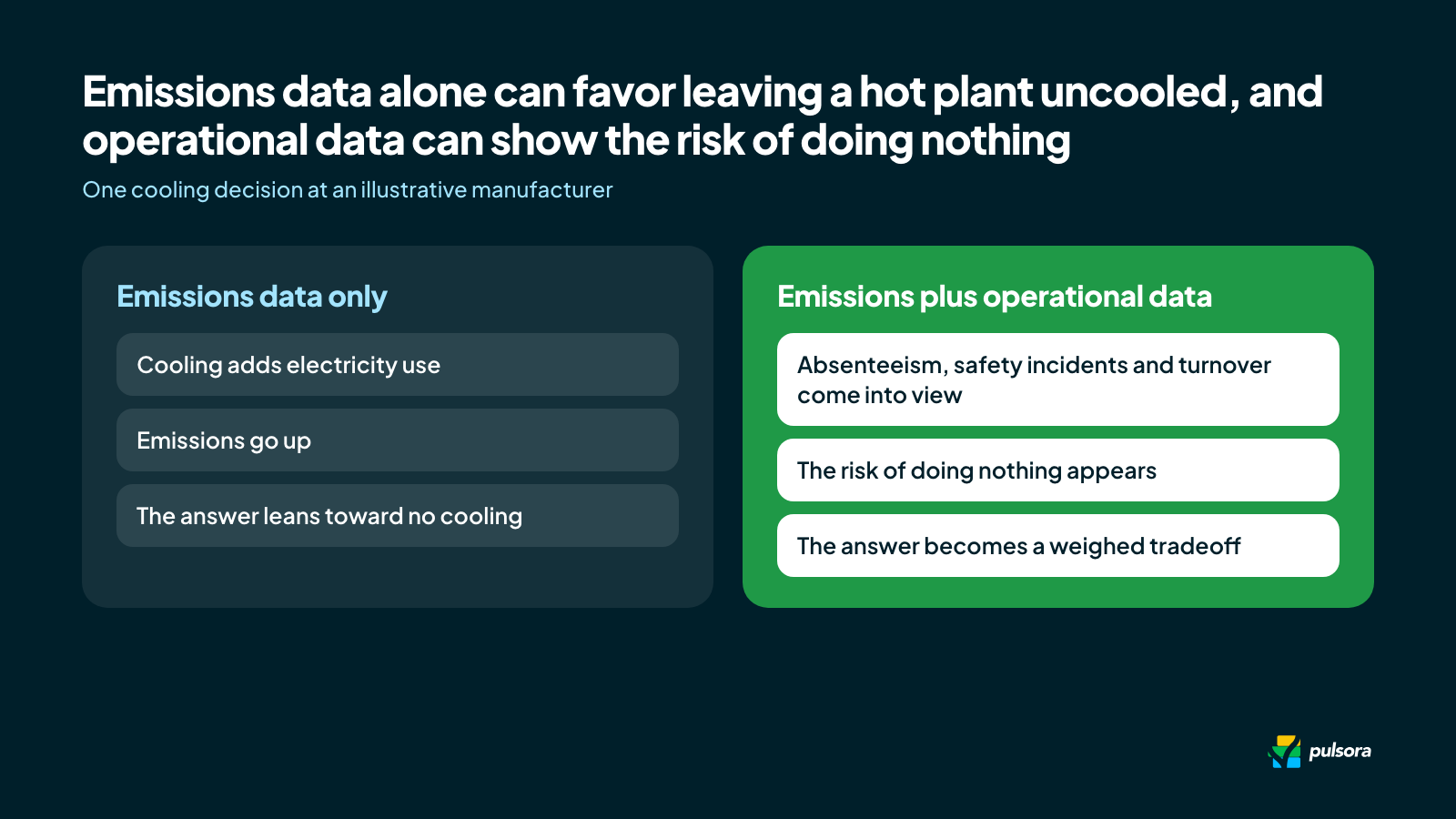
Imagine a global manufacturer with factories in several countries. As extreme heat becomes a regular threat, it considers installing air conditioning in its plants. On emissions alone, this looks like a step backward: more cooling means more electricity use and higher emissions. If the decision rested only on that data, the answer would likely be to leave the plants as they are.
Emissions are one part of the story. When the company connects data from across the business, such as absenteeism, safety incidents and employee turnover, a different picture can emerge. Heat affects safety: a study of California workers' compensation claims from 2001 to 2018 found that hotter temperatures increased workplace injuries, in indoor settings such as manufacturing and warehousing as well as outdoors [1]. Layering the company's own data on top of its emissions data can point to what going without cooling might cost in sick days, safety risk and difficulty keeping staff in critical roles. Those records show associations, not proof of cause, and the California study does not describe this company. The emissions impact is real, and the operational risk of inaction may be too.
What is new is the scale and speed of these connections. Pulling together energy use, HR records and safety logs used to take a dedicated team and weeks of manual work. Pulsora's view is that AI-enabled data modeling could shorten this to minutes once the data sources are connected, and could refresh the picture as new data arrives. That speed is a possibility, not a measured result. Companies can weigh real-world tradeoffs across data that no single spreadsheet covers.
A team models its options, ranks their impact, then tests the ranking
Modeling the options. A model lays out several paths, such as a supplier, a cooling system or a capital project. It then projects emissions, other environmental and social impacts, and cost for each. That gives a team options with data attached instead of guesses.
Ranking their impact. The cheapest supplier and the lowest-impact supplier are often different. Ranking by convenience first tends to lead a team to justify the easy choice instead of testing it against a harder option with greater impact.
Testing the ranking. A team needs to explain why it chose this option and not another, tracing every data point back to its source. Traceable data, the experience of peers and the company's own trajectory together help a team judge whether the choice is likely to make a real difference.
Modeling a few options has long been part of sustainability work. A person can compare five suppliers or five cooling systems and get a rough sense of their emissions with a bit of research. A person cannot trace how a decision of that size ripples through a complex system or supply chain, several steps out, in the time it takes to make the call. AI could work through that network of possibilities in far less time than weeks or months, though no measured benchmark is cited here. It can also rerun the work as new data arrives, so teams can adjust their plans often instead of once a year.
A coming regulation can change sourcing, documentation and staffing as well as cost
Consider a regulation that has been adopted but does not yet apply. It bans a material the company currently sources, or requires tracing a material's origin to rule out forced labor further up the chain. The European Union's Forced Labour Regulation is a real case: from 14 December 2027, no product made with forced labor may be sold in or exported from the EU market [2].
The effect reaches well beyond one line item. It changes the supply chain and the documentation operations must keep. It reaches finance, procurement and HR, because a supplier relationship or sourcing region may no longer be viable. Modeling that ripple across every function used to take weeks or months, and often left the sustainability team, which usually guides the rest of the organization, working from best guesses under pressure. With a model that understands how those functions connect, the same picture can take shape far faster.
The logic is the same as in the supplier and cooling examples, one step further out. Those examples ask which option has the most impact today. Regulatory foresight asks which option still looks right once a rule not yet in force takes effect. A supplier that looks best under today's rules can look far less attractive once the cost of a coming disclosure rule in its home country is counted.
Sustainability leaders keep the judgment, the risk and the responsibility
None of this modeling and ranking removes human judgment. An assessment depends on data and assumptions, and both matter equally. Activity data from smaller suppliers can be incomplete. Emission factors vary by source and region [3]. Assumptions about the future energy mix or the timing of new rules are estimates, and different reasonable assumptions can raise or lower a ranking.
That is why the team stays in the loop. It decides which assumptions make sense, which data gaps need closing before a ranking is trusted, and which option deserves a second look even if the model ranks it lower. Someone has to answer for the decision, so AI cannot have the last word. A model does not work inside the business and may lack data the team knows about, so the team makes the final balance between options and bears the responsibility and the risk either way.
What changes is when the team sees the consequences of the choice it is about to make. Seeing clearly what an AI model's output is built on is also what it takes to trust it.
AI gives sustainability teams the information to choose better before they commit
A report, however accurate, arrives after the decision is made. AI gives sustainability leaders the information they need to make a better decision for the business, whether that means cutting emissions, weighing options against each other or reducing the risk of a sudden change in regulation.
The responsibility itself stays with the team. What AI adds to sustainability decision-making is a clear view of what each option would do, early enough to choose it.
Pick one decision your team has open this quarter, such as a supplier contract or a capital project, and list the emissions, compliance and people impacts of each option before it goes to sign-off.
FAQ
What is AI sustainability decision-making?
It is the use of AI to project the emissions, compliance and social effects of each option before a team commits to one. The team reviews the projections and makes the choice.
How does AI help sustainability leaders make better decisions?
Data that would take a team weeks or months to gather by hand, such as supplier emissions, safety records, absenteeism and turnover, can be connected in one place. Teams can then compare options on their full impact and rerun the comparison as new data arrives.
Does AI replace annual sustainability reporting?
Reporting continues, because many disclosure rules run on a yearly cycle. Teams act on projections during the year and report on results at year end.
Can AI estimate a supplier's emissions before a contract is signed?
AI can estimate a supplier's footprint from activity data, supplier-reported data and emission factors, and can flag suppliers that rely on coal-based energy, which a team then checks against the rules that apply. An estimate is only as complete as the supplier data behind it, so data gaps need closing before the ranking is trusted.
Who stays responsible for a decision when AI is involved?
The sustainability team does. AI produces projections built on data and assumptions, and the team reviews those assumptions, checks for gaps and decides which options deserve a closer look.
How can companies prepare for a regulation before it takes effect?
Map how the rule would affect sourcing, documentation and staffing well before its deadline, then project the effect on each supplier and sourcing region. Start with the rule's date of application and the materials or regions it covers.
References
- Park, R. J., Pankratz, N., and Behrer, A. P. "Temperature, Workplace Safety, and Labor Market Inequality." IZA Discussion Paper No. 14560, July 2021. https://docs.iza.org/dp14560.pdf
- European Commission. "Forced Labour Regulation" (Regulation (EU) 2024/3015). https://single-market-economy.ec.europa.eu/single-market/goods/forced-labour-regulation_en
- U.S. Environmental Protection Agency. "GHG Emission Factors Hub." https://www.epa.gov/climateleadership/ghg-emission-factors-hub


